

The TIDAL Contriva Loudspeaker
| The TIDAL Contriva Loudspeaker |
| World Class Loudspeakers from Germany |
|
|
|
February 2009 |
 I first learned of the German audio equipment manufacturer, TIDAL, a few years ago when I met their U.S. distributor, Daniel Barnum of Half Note Audio. He brought the company’s fine amplifier and preamplifier, the Impact and Preos, respectively, and gave me a brief history of the company and what makes their products so unique.
The Impact and Preos took up residence in my listening room for several months and churned out some really fine music, and rewarded me with months of memorable listening sessions. When Daniel told me that TIDAL also builds loudspeakers that perform just as well, I was a bit skeptical. Rarely do you find manufacturers who do both electronics and speakers equally well. Actually, GamuT does a pretty good job of this, but I felt they were more the exception than the norm. Besides, as much as I liked the TIDAL amp and preamp, and I liked them a lot, I wouldn’t say that I felt like, “I just have to have these electronics otherwise life won’t be the same.” Still, when Daniel offered me the opportunity to review the TIDAL Contrivas, I figured it would be another opportunity to review a world-class speaker and put another feather in my cap. Daniel invited me to come by his room at the 2008 CES so I could get a preview of what I would be reviewing. I made my way over to the room where Half Note Audio was doing their demo and saw the speakers for the first time. I must admit to being impressed by my first encounter with this speaker, and I became genuinely excited about reviewing it.
Where did the TIDAL speakers come from?
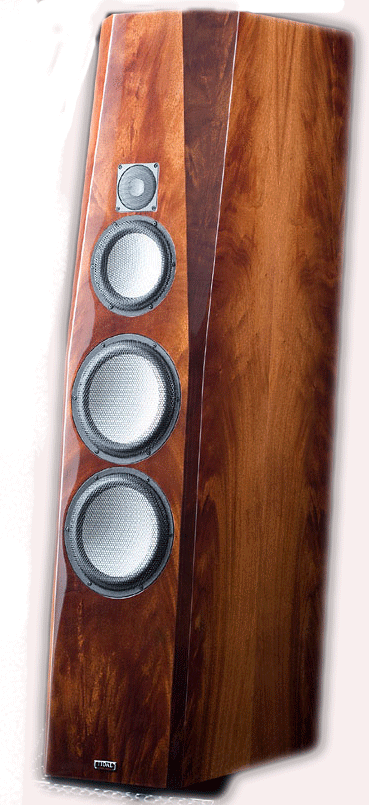
Not long after that CES, the TIDAL Contrivas were delivered to my home by Daniel Barnum himself, and I had to admit, the speakers seemed more impressive in my listening room than they did at CES. They arrived in flight cases, one for each speaker, a very nice touch, I must admit. I was impressed by their build quality when I saw them at CES, but up close and personal, in my listening room, where I could put my hands on them and give them the once-over, I was even more struck by them. The craftsmanship was beautiful and, in fact, first-class in every respect. I thought the GamuT L7 was the most beautiful speaker I had beheld in my listening room to that point, but the Contrivas took my breath away. I had to ask myself, “Just who are these TIDAL people and how come I hadn’t heard anyone talking about them prior to me having them in my listening room?”
I first met TIDAL’s founder, Jorn Janczak, on day one of the 2008 CES. I didn’t know who he was, and we only spoke in passing. But the next day, when I saw him, we shook hands, exchanged pleasantries, and talked a bit about my Impact/Preos review and my upcoming review of the Contriva.
I could try to describe the look and feel of the Contrivas to you, but it would be an exercise in futility. A lot of the descriptors I would use have already been used and would sound like I was repeating clichés, especially after using them to describe the GamuT L7 speakers. I can confidently say that I have not encountered a better-made speaker before the Contrivas arrived in my listening room. That includes most of what I can remember from my speaker-reviewing experiences and all of my CES experiences. The Contrivas measure a hair above 51″ in height, 11″ wide, just about 19″ deep and a very, very solid 200 lbs plus each. The cabinet is made from 2”-3” HP-MDF. Try rapping your knuckles on the top or side of the Contrivas. You’ll hurt your hand before you hurt the speaker. The driver complement consists of one 7” midrange and two 9” Accuton low-range drivers with white ceramic diaphragms. The tweeter is a 1.2” Accuton driver, also with a white ceramic diaphragm. The midrange driver is custom-made for TIDAL along with some crossover parts. The finish on all TIDAL speakers is exquisite and a sight to behold. The finishes have exotic names like tiger-eucalyptus, curled bubinga, rose bubinga, African pyramided mahogany, and ebony macassar. You can get finishes in high gloss or non-glossy finishes to suit your tastes.
TIDAL Contriva performance…
Not long after that CES, the TIDAL Contrivas were delivered to my home by Daniel Barnum himself, and I had to admit, the speakers seemed more impressive in my listening room than they did at CES. They arrived in flight cases, one for each speaker, a very nice touch, I must admit. I was impressed by their build quality when I saw them at CES, but up close and personal, in my listening room, where I could put my hands on them and give them the once-over, I was even more struck by them. The craftsmanship was beautiful and, in fact, first-class in every respect. I thought the GamuT L7 was the most beautiful speaker I had beheld in my listening room to that point, but the Contrivas took my breath away. I had to ask myself, “Just who are these TIDAL people and how come I hadn’t heard anyone talking about them prior to me having them in my listening room?”
The Contrivas speak with an uncanny tonal balance from top to bottom, neither bright nor dark nor dull, but fully natural and neutral. For you folks who like to dissect music into parts, here’s my attempt. Bass is authentic and authoritative, with enough energy and extension to excite the room when the music calls for it, but refined enough that you can follow along with the pitch and rhythm we tend to take for granted in the lower registers. TIDAL’s midrange performance is as close to realistic as I have heard. I have commented on Contriva’s performance within the presence range, as they continually transported me to the recorded event. Image portrayal, though dependent on the quality of the recording, was at times startling. My notes contain observations that don’t lean towards descriptions like width, height, and depth, but are more about pinpointing where in my room the performers are in relation to each other, from side to side and front to back. The Contrivas focus images uncannily, which adds to its lifelike staging capabilities. High frequencies are extended and insightful without a hint of harshness or stridency, unless it’s in the recording. Triangles, bells, and other high-frequency percussive instruments exhibit realistic decay when played through the Contrivas.
Let’s now consider the Contriva’s performance with recording references. One of the Contriva’s strengths is its ability to replicate the complexities of piano music. The Contrivas did an incredible job of this and are easily the best speakers I have heard in my listening room and in most other places I’ve visited for reproducing piano music. Played through the Contrivas, the sound of a Steinway piano comes through distinctly different from that of a Bosendörfer.
Earl Wild, playing piano on Tchaikovsky’s Piano Concerto No.1 [Chesky Records], kept me mesmerized. I had not heard this piece sound as rich and nuanced before. I’ve always thought it was pleasant to listen to, but through the Contrivas, there was much more information, detail and emotion with this piece that I had not experienced at as high a level before. I usually listen to this piece for its wonderful orchestral accompaniment. Now I listen to the orchestral parts as a way to get to the piano music.
 One of my favorite references of late has been Joel Grare’s CD, Paris-Istanbul-Shanghai[Alpha]. Not only is this disc beautifully recorded, but it also features well-executed performances with an international flair (Spanish, Chinese, and Turkish), as the title suggests. The first track, which is also my favorite, is titled “Nihavent”, and features Mr. Grare playing a traditional Chinese two-stringed instrument called a “Guo Gan.” The tone of this instrument is both warm and extended in the upper registers but never strident, especially for a stringed instrument. Played through the Contrivas, I felt as though I was there with the group, as I could easily follow the ebb and flow of the melody, the instrumentalist’s breathing, and Mr. Grare’s fingerwork on the Guo Gan.
Now on to some of the Contrivas other strengths, such as its soundstaging and imaging capabilities. On very good live recordings with carefully set-up microphone placement, these speakers are more than capable of capturing the width and depth of the venue without drawing attention to themselves. I mean big images, fast, clear, and on the best recordings, a lifelike quality that I have heard on very few systems. Their speed and accuracy are about as truthful as it gets. I check imaging and tonal balance with Vivaldi’s The Four Seasons; Flute Concerto in D [Chesky]. With the Contrivas in place, the performers are smack where they ought to be, and stay there. The image is quite deep, and even the soloist has his own place, unlike some that extend speaker to speaker.
Final thoughts on the Contrivas
This review has been harder for me to write than most. On the one hand, they have been the best speaker overall that I have had in my listening room, and an absolute joy to review. This is definitely one of those pieces of equipment that I hated to see leave my listening room. On the other hand, they made me reassess what I have been listening to, in terms of music, and what to look for performance-wise. It’s sort of like getting my ears tuned up and reflecting upon what is important to me in terms of my listening biases.
The TIDAL Contrivas are among the fastest dynamic speakers I’ve heard, in their ability to replicate lifelike detail and transient information. One could argue that the Contrivas might not be quite as fast as electrostatics; however, that argument would not come from me. I can say I found the Contrivas infinitely more musical and natural-sounding than my Martin-Logan Quests. Yes, I know the Contrivas are far more expensive than the M-Ls, but remember, I am a lifelong lover of electrostatic speakers, and I confess to this.
In terms of compatibility, the Contrivas did not prefer solid-state to tubes or analog to digital. All were treated equally well and given the ability to “strut their stuff.” I got excellent results with the Contrivas driven by the big 600-watt-per-side XLH M-200 mono amplifiers. The M-200s allowed the Contrivas to showcase their breathtakingly visceral low-end capabilities and their ability to replicate lifelike transients. Oddly enough, my favorite amplifier on the Contrivas was the wonderful Chalice Audio mono amplifiers. Music listened to with the Contriva and Chalice combination in place was, for lack of a better phrase, “excitingly real.” I have heard the Contrivas driven by the highly regarded TIDAL Impact and Preos combination, and the ASR Emitter II, both of which deliver high performance, whether you prefer solid-state or tubes. The vacuum tube-based Chalice monos have that certain magical quality that, when matched with a pair of speakers like the Contrivas, allows you to experience music at the highest level.
The cables I used during this review were from Silversmith and Stealth Audio, which did an excellent job of bringing the music home, but I did most of my listening with the impressively sounding Dynamic Design Ultimate Series cables. As enjoyable as the musical experience was with these cables, the Contrivas did their best work with the formidable Argento cables in the system. The Argento cables let all of the information flow upstream in the audio chain, to be revealed at the highest level by the Contrivas.
I hate to admit it, but I went through some serious withdrawals when the Contrivas went back home. I missed the things the Contrivas did so well: revealing music at a high level of performance from top to bottom. I found that I needed to reassess my criteria for what I listen to in future reviews, and to look at my finances to see whether I could purchase a pair of Contrivas. I was quite successful in one of these endeavors and failed miserably in the other.
Keeping in mind that I have not heard every loudspeaker in existence, still, I’d be hard pressed to imagine that there is a loudspeaker significantly better than the Contrivas. When you take into account their thoughtful design, quality of finish, solid build quality, and stunning musical virtues, you get a speaker that could be on anyone’s short list of the ultimate loudspeaker. Probably the highest praise I can give the Contrivas is that not only did I have the usual group of friends and acquaintances come over to listen to them during this review period, but they would also routinely ask if they could invite their friends over to experience them as well. I give the TIDAL Contrivas my “highest” recommendation.


Tidal Contriva Specifications:
RMD-cabinet, crafted in tongue and groove, made from 2″-3″ HP-MDF
2 x 220 mm (9″) Thiel & Partner (Accuton) woofer with white ceramic-diaphragm
1 x 173 mm (7″) Thiel & Partner (Accuton) midrange-woofer with white ceramic-diaphragm
1 x 30 mm (1,2″) Thiel & Partner (Accuton) tweeter with white ceramic-diaphragm
Mechanical and pressure-isolated passive crossover network laid out with ultra-low-tolerance components
Exclusive use of silver/gold/oil- and copper-MKP-capacitors, metalfilm-resistors and air-core-inductors for longest term stability
Extremely linear frequency response, excellent step response, optimized phase and group delay
Massive silver/gold-plated soft-copper binding posts with removable heads for full-size eylets, spades, and bananas. Serial accessories: 2 professional ATA-flightcases on wheels, stainless-steel isolators (16 parts), chrome-plated stand-bars for a safer stand, microfibre-cleaning cloth, owners manual leatherbook with its personal measurement protocols
Serial cabinet finish, high gloss polished piano lacquer: midnight black
Optional veneer-group 1, high gloss polished woods in piano lacquer: tiger-eucalyptus, curled-bubinga, rose-bubinga
Optional veneer-group 2, high gloss polished woods in piano lacquer: african pyramided mahogany, ebony-macassar
Alternative choice for veneer-group 1 and 2: natural silky-dull finishes (non-glossy finish with a noble silky-dull shining)
other wishes or veneers: on request.
Drivers: 2 x 9″ woofer, 1 x 7″ woofer, 1 x 1,2″ tweeter
Nominal power input: 150 / 300 VA
Nominal impedance: 4-6 Ohm, very easy to drive with tube amps
Recommended amp input: quality instead quantity, 10 watts or more at 8 ohms
Frequency response: very linear, F3 = 29 Hz
Efficiency: 88 dB – 92dB (depends to the way of measurement)
Dimensions: 51,2″ x 11″ x 18,9″ / 130 cm x 28 cm x 48 cm
weight: approx. 506 lbs. / 230 kg (with packaging)
Price: $60,900 in African Mahogany
Company Information:
TIDAL Audio GmbH
Immendorfer Strasse 1
50354 HUERTH
GERMANY
Phone: +49 (22 33) 966 92 25
Fax: +49 (22 33) 966 92 26
Website: www.tidal-audio.com E-Mail: contact@tidal-audio.de
USA Distributor:
Half Note Audio
P.O. Box 503
DeKalb, IL 60115
Tel: 847-232-1267
Website: www.halfnoteaudio.com
E-mail: contact@halfnoteaudio.com

 Don’t forget to bookmark us! (CTRL-SHFT-D)
One thought on "The TIDAL Contriva Loudspeaker"
Leave a Reply



Stereo Times Masthead
Publisher/Founder
Clement Perry
Editor
Dave Thomas
Senior Editors
Frank Alles, Mike Girardi, Russell Lichter, Terry London, Moreno Mitchell, Paul Szabady, Bill Wells, Mike Wright, and Stephen Yan,
Current Contributors
David Abramson, Tim Barrall, Dave Allison, Ron Cook, Lewis Dardick, John Hoffman, Dan Secula, Don Shaulis, Greg Simmons, Eric Teh, Greg Voth, Richard Willie, Ed Van Winkle, Rob Dockery, Richard Doron, and Daveed Turek
Site Management Clement Perry
Ad Designer: Martin Perry
The tweeter is not a white ceramic diaphragm, but a 30mm Accuton diamond tweeter. Everything else in this review is spot-on from my experience.