

Bricasti M21 DAC
 My journey in high-end audio has evolved immensely over the past 15 years. I have had the luxury of experiencing a wide range of audio equipment by purchasing, auditioning, and reviewing. Over time, I have improved my system by attending audio shows, auditioning, and reading comprehensive reviews. One of the most complex audio decisions I’ve had to make was moving on from my beloved Behold Audio gear. Since 2008, I have had the pleasure of firing up my Behold Audio gear to settle down for great listening sessions. However, I decided to change due to the age of my Behold gear and my curiosity about exploring the world of audio tubes.
When I switched from solid-state to tube gear, I carefully researched and chose the Thrax Spartacus 300B Amplifier and the Thrax Libra Preamp. In the meantime, with the Behold BPA768 and APU768 Preamp, the Behold amps incorporated multiple DACs, so an external DAC was unnecessary. Now that I had the Thrax gear in my system, I no longer had the luxury of internal DACs in the amps; thus began my search for a DAC that would complement the Thrax gear.

This review will explain why I chose the M21 over the 2 previously mentioned DACs. Once again, all 3 DACs were in a class of their own, and I would have been happy with any of them. Unfortunately, I had to decide which unit best fit my budget and long-term system.
Two main factors that drove my final decision were price and performance. The $6400 P.S. Audio Direct Stream would have complemented my system without a hitch; as far as performance is concerned, it held its own against the other 2 DACs; however, I felt the Direct Stream was a tad light in the areas of dynamics and imaging in comparison to the other two DACs while paired with the Thrax Spartacus and Libra. Price-wise, you cannot beat what the P.S. Audio Direct Stream DAC offers.
The $38,000 Thrax Maximinus DAC perfectly matched the Spartacus and Libra. It outperformed the other DACs in pure natural sonics, especially with its vivid analog presentation. Honestly, my budget was not ready to take on such a high-priced component. However, when I installed the $17,000 Bricasti M21, I was shocked at how close it performed to the Thrax Maximinus. The Bricasti performed flawlessly in the sonic realm; transparency was spot on, and imaging projected a sense of meat on the bones. I must admit that compared to the Thrax Maximinus, the Bricasti did not project the analog feel of the unit as mentioned earlier; however, that does not mean the Bricasti did not sound analog, just not to the $38,000 Thrax Maximinus standards. Ultimately, my decision was based on price-to-performance. Now that I have made the tough decision to roll with the Bricasti M21, I can detail the factors that prompted it.

Brief Description
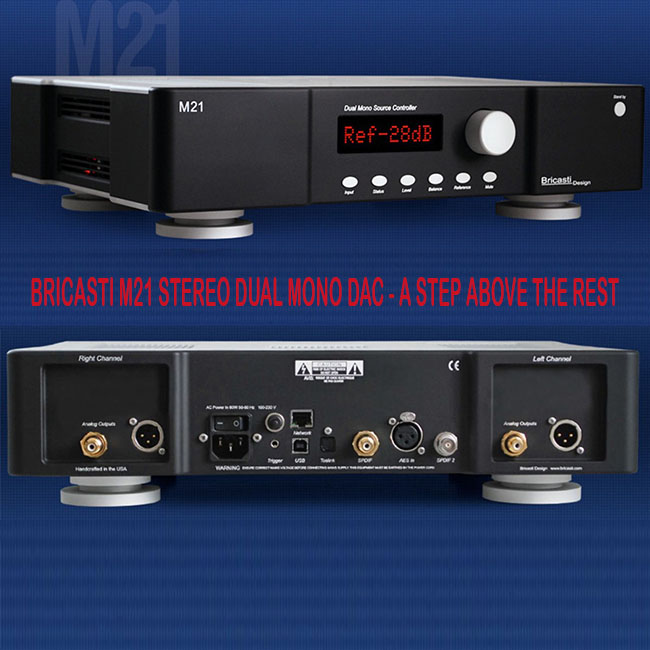
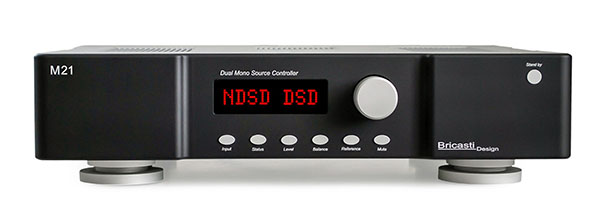
The Bricasti M21 is a fully balanced circuit-path D/A converter that includes separate, isolated power supplies for each channel. This DAC incorporates a pair of AD1955 Analog Devices chips in a dual-mono configuration. The M21 also incorporates an optional Ladder DAC for PCM conversion; each channel is clocked directly at the DAC using a technique called DDS (direct digital synthesis), which reduces clock-induced jitter to immeasurable levels, and DSD is converted using its one-bit analog converter. There are four primary internal sections in the M21: the digital input and processing section; the left and right analog and PCM DAC sections; and the left and right analog line amps with pure DSD conversion, optionally with analog level control. The Bricasti M21 provides a network interface on the rear panel with an R.J. 45 Ethernet connection.

Build Quality
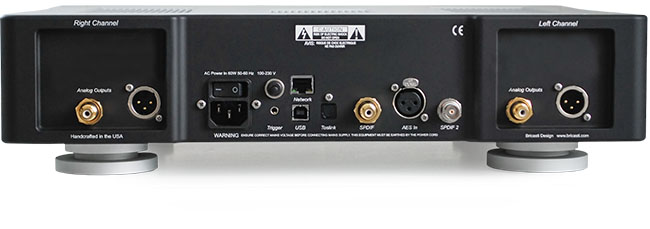
The M21 is constructed with “quality in mind”: the case is black, reminiscent of a Mark Levinson design, with a rugged black case and silver top, all machined from solid aluminum. To be more specific, all sections of the construction, the front and rear panels, the sides, and even the bottom and top plates are constructed with solid blocks of aluminum that are precision-machined to shape, with exact tolerances for a perfect fit. Remember the four circular stainless-steel Stillpoints feet, which provide a vibration-control platform. The engineering design of the M21 is first-class.
Setting up the Bricasti M21 was straightforward: plugging in an A.C. power cord and the associated input and output interconnects. Next was choosing the DAC (NDSD, Sigma, or Ladder). Ensure the level control is set to 0 dB. Setting filters is an option that I played with a bit later in the sound phase. To better understand the filter settings, I contacted the manufacturer, who provided excellent guidance. Communication with the designer was very helpful in getting and keeping me on the right track. I commend Bricasti for its superb customer service.
Initial impressions
The disappointing aspect of this review is that I can report my observations only on the M21’s capabilities with Redbook. I only listened to Redbook CDs as of this writing; I needed SACDs. However, the M21 did a fantastic job on the Redbook format. I will also report on audio streaming, which the M21 performed flawlessly.

The sonic transparency, clarity, imaging, and sound staging were much better than I was accustomed to with other DACs. I was impressed by how the M21 captured every minute detail with incredible clarity, organic realism, and natural reproduction. Instruments sounded lifelike without that artificial digital airiness. The different timbres perfectly separate the bass, complementing the upright bass instrument’s strings. The balance and presentation of instruments were like attending a live concert that touched the ear and aesthetic of individual musicians.
Using the Ladder DAC with its filter options, I eventually settled on “Linear-1”; I felt this option best suited my taste. Choosing “Linear” gave me a more open midrange and a better feel in the bass.
Sometime down the line, I will listen to more up-sampled SACD music in addition to Redbook Compact Discs; however, the M21 is everything I need until I upgrade my CD transport.
Listening to the M21 connected to my Auralic Aires G2.1 network streamer was also a rewarding experience. The M21 provides the capability to stream audio; however, since I am used to streaming audio through the Auralic Aires G2.1, I decided to listen with the component connected to the Bricasti M21. The results were on point, and I felt the streaming audio effects were on par with what I heard compared to music from my transport playing Redbook C.D. Finally, the M21’s timing, transparency, and resolution while listening to streaming were astounding.
 Listening Observations/Audio Authority
The Bricasti M21 impressed with its clarity, transparency, overly rich bass, and airy highs. These results were apparent from the following music selections. Mark Isham’s “Blue Sun” presented a musical treat that floored me. I first heard the Blue Sun CD in 2007 while visiting Mr. Clement Perry’s house. I was blown away and never forgot the experience. My favorite track, “That Beautiful Sadness,” played through the M21, drew me into the very soul of what the artist intended. Just a great music track that has it all, especially for the critical listener. Mark Isham closely imitates Miles Davis with his great horn playing. Listening to this track playing through the Thrax gear and the Bricasti M21 was the best I have heard this CD sound in my listening room. Throughout this CD, Mark Isham struts his brilliant jazz talent. Isham’s quintet includes Steve Tavaglione on tenor saxophone, David Goldblatt on piano, and the rhythmic section of drummer Kurt Wortman, who plays this music with grace and elegance. This CD/Album is a must for the jazz enthusiast.
 The late, great Al Jarreau will always have a special place in my heart among jazz singers. The 2004 recording of “Accentuate the Positive.” It is centered around songs from the 1940s. On this album, Al Jarreau was in top form, displaying limber and evocative vocals throughout each track. Accentuate the Positive moves from uptempo to bluesy tracks, culminating with Eddie Henderson’s famous “Cold Duck Time.” The M21 in the music chain helped turn “Ac-cent-tuate the Positive” into a funky, expansive toe-tapper. The M21 did not disappoint, missing a beat or note while playing this solid, poignant, and straight-ahead album. Instead, the M21 helped showcase Al Jarreau’s unique, gifted voice at its best.
 Diana Krall is one of my favorite artists when I need to sit down and unwind. Her superior vocal talents and a second-to-none Jazz ensemble do it for me every time. When I sit down to listen to her on the CD “This Moment On,” I know I can relax and immerse myself in the music. With the addition of the M21, listening to this CD does it for me. While Diana Krall has always been a pleasant presence, she is also a developed and talented pianist. On the CD “This Moment On,” Diana showcases her rhythmic chops, both vocally and on the keyboard, while listening through the combination of Thrax and the Bricasti M21. Backing her is the beautiful sounds of Clayton-Hamilton Jazz Orchestra, featuring punchy and solid solo spots by trumpeter Terell Stafford and the rhythm section talents of guitarist Anthony Wilson, bassist Robert Hurst, and drummer Jeff Hamilton. Listening to this CD with the M21 in the electronic chain brings me closer to when I heard a live performance by Diana Krall a few years ago. She is a fantastic/talented jazz artist.
Conclusion and Final Thoughts
It would be challenging to find a more formidable, affordable DAC capable of what the Bricasti M21 brings to the table. While the Bricasti M21 may not be the final word in the DAC world, it certainly makes its presence known. For the money, performance, and comparison to other DACs I have experienced, the Bricasti is a no-brainer. The Bricasti M21 provides a sense of sheer spaciousness, mimicking a sound more coherent to a concert venue. The sound, price performance, ease of operation, and build quality are all first-class. Highly, Highly Recommended. My 2022 Most Wanted Component.


Moreno Moreno
Bricasti M21 Specifications:
Price: $16,000
Front Panel Overview
- Front Panel has a large, simple easy to read display
- Front panel Power stand-by switch
- I.R. receiver built in for remote control operation
Rear Panel Overview
- Left and right analog output section
- 6 digital audio inputs (AES, SPDIF 1 and 2, Toslink, USB, and RJ45)
- Power connection
- Rear panel mounted circuit breaker
Operating Overview
- Input Select
- IN1 AES, Selects the XLR connector
- IN2 SPDIf Selects the RCA SPDIF connector
- IN3 EIAJ Selects the Toslink connector
- IN4 USB Selects the USB connector
- IN5 LAN and network streamer
- IN6 SPDIF 2 Selects the BNC connector
Digital Oversampling Filters for PCM conversion
- Minimum Phase
- Linear Phase
- Delta Sigma 8 x oversampling conversion
The M21 Remote
- Dedicated infrared remote control
- Six button operation
- Palm-sized for easy operation
General Specifications
- Anodized Aluminium
- Dimensions 17” x 12” x 4.5”
- Weight 15 lbs
- Shipping Weight 18 lbs
Mains Voltage
- 100, 120, 220, 240 VAC
- Power Consumption 30 Watts
- Warranty Parts and Labor 2 years non-transferable
- Roon Ready
Bricasti Design Address
- Bricasti Design, Ltd.
- 2 Shaker Rd, Bldg. N
- Shirley, MA USA 01464
- PH 1.978.425.5199
Moreno’s Associated Equipment
Analog
Thrax Spartacus 300B Amplifier
Thrax Libra Preamp
Canary C10 Phono Amp
Pro-Ject RPM 10 Carbon Turntable/ Van den Hul Stradivarius Cartridge
Otari MX5050BII2 Reel-Reel Tape Machine
Digital
Bricasti M21 DAC
Thrax Maximinus DAC
P.S. Audio PerfectWave Transport
Auralic Aires G2.1 Network Transport
Network
Auralic Aires G2.1
Roon Neutrilik
Sean Jacobs Power Supply
EtherRegen Switch
Speakers
Y.G. Acoustics Sonja 2.2i
REL G1 MKII Subwoofers 4-Stack
Cables
Hemingway
Sigma Speaker and Power Cords
Beta Interconnects
A.C. Conditioners
P.S. Audio P20
Sound Application TT-77
Accessories
Townshend Audio Seismic Platforms
StillPoints Stands S.S. Ultra 6’s
StillPoints Equipment Rack
Synergistic Research Black Box



Stereo Times Masthead
Publisher/Founder
Clement Perry
Editor
Dave Thomas
Senior Editors
Frank Alles, Mike Girardi, Russell Lichter, Terry London, Moreno Mitchell, Paul Szabady, Bill Wells, Mike Wright, and Stephen Yan,
Current Contributors
David Abramson, Tim Barrall, Dave Allison, Ron Cook, Lewis Dardick, John Hoffman, Dan Secula, Don Shaulis, Greg Simmons, Eric Teh, Greg Voth, Richard Willie, Ed Van Winkle, Rob Dockery, Richard Doron, and Daveed Turek
Site Management Clement Perry
Ad Designer: Martin Perry
Be the first to comment on: Bricasti M21 DAC