

Mola Mola Tambaqui DAC by Clement Perry
 High-end distributor Bill Parish of GTT Audio and Video serves as the U.S. importer/distributor for bespoke audio brands such as AudioNet, Kii Audio, YG Acoustics, and Mola Mola. Parish always invites me out when something new or special arrives. A regular visitor to Parish’s South Jersey showroom, I was impressed by my first audition of the all-new Mola Mola products in the Kaluga mono amps and Makua preamp combo. Parish himself was quite impressed by this combo, hearing driving a pair of YG Halle loudspeakers. Upon entering his impressive listening room, I noticed sitting right beside the Mola Mola’s Kaluga mono amps was a colossal pair of Soulution mono amps. They were so large I had accidentally mistaken the Kalugas for power supplies rather than power amps. I think Parish had them side by side on purpose. He intended to show that, though many times smaller (and less expensive), the Mola Mola combo could hold its own against such behemoths as the world-renowned ($150K plus) Soulution gear. Since audio memory is sketchy at best, I did not compare the two since it had been some time since my last visit. Duly noted, the Kaluga’s power output of 400 watts per side (at 8 Ohms), left an indelible imprint on both myself and senior writer Greg Voth. The speed, openness, and overall conveyance of power in such a small package proved very impressive.
Snooping around Mola Mola’s website revealed some compelling reasons behind the impressive-sounding Makua and Kaluga combo: The innards of the Mola Mola, including its DAC chips and circuit motherboard, were designed exclusively in-house. Also, the company states, “…the audio circuitry is trimmed to the bare bones and board-to-board connectors are eliminated in favor of soldering star-quad cables directly into the circuit board for the cleanest, lowest impedance connection possible.” There was certainly a lot going on in terms of sheer resolution, dynamic liveliness, and depth of soundstage. Minus the lowest octaves that I somehow felt were not as out-of-this-world as in my previous listen with the Soulution gear, and if Parish hadn’t told me what was playing, I would have assumed the Soulution gear was powering the system. There was just too much information coming from something so little and, well, cute. Now, if Parish purposely left those big Swiss amps so close on purpose, then, ladies and gentlemen, it worked like a charm.
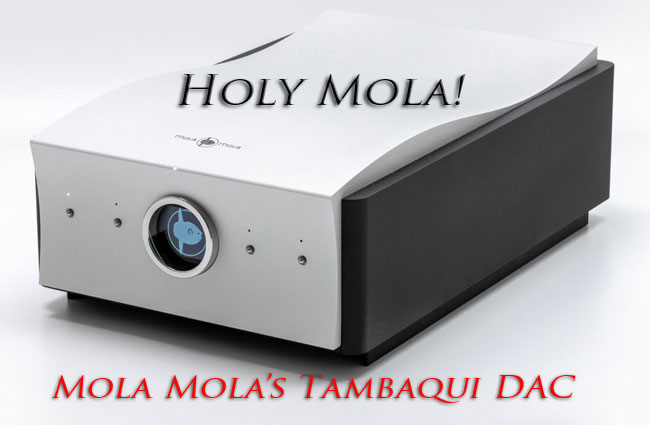
 The Mola Mola Tambaqui is the company’s newest product and its first stand-alone DAC from a new high-end company based in the Netherlands. Not surprisingly, the Tambaqui uses the same specialized DAC as the Makua preamp. It’s uniquely designed for the music lover who seeks a digital upgrade but wants to keep their beloved preamp. Bruno Putzeys exclusively designs Mola Mola gear (yes, the same guy behind Hypex, Grimm, and Kii fame). And the Tambaqui’s internal DAC chip and circuitry were designed by Putzeys from the ground up, starting with dual DAC chips mounted on a two-board stack. All incoming digital data is upsampled to 3.125MHz at 32 Bits on the first board. The other houses two mono DAC’s, in which a discrete 32-stage FIR DAC converts the PWM into analog (with a reported breathtakingly low 130dB signal-to-noise ratio). According to the information gleaned from Mola Mola’s website, this is near the theoretical limit for 24-bit files and far beyond that of even quad DSD.
.jpg?KeepThis=true&TB_iframe=true&height=430&width=700)
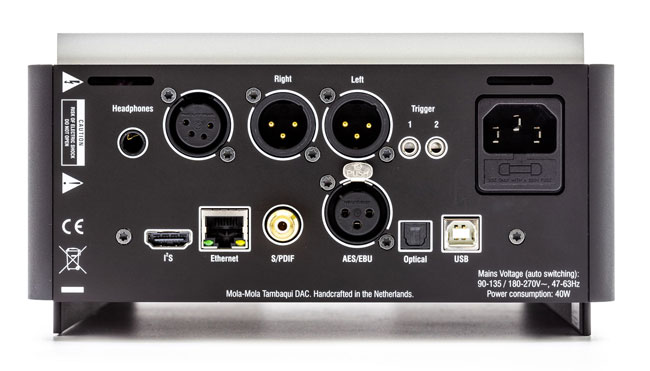
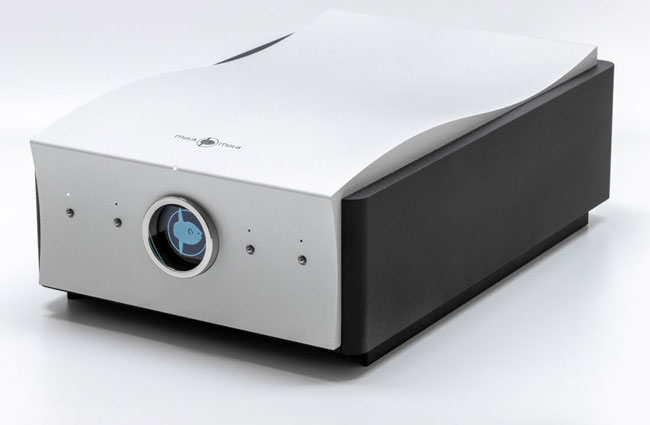
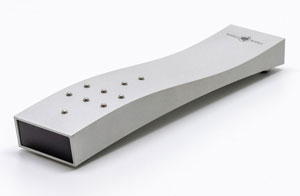 Physically, the Tambaqui feels very well-built in its curvaceously sloped two-toned (silver case and black sides) aluminum chassis. Taking it out of its box and carrying case gave it a more substantial feel than I expected from its size. Peering at it on my rack from my listening seat, I found the Tambaqui’s soft-white LEDs give it a more discreet appearance (especially when listening late at night or preferably in the dark). Glancing at the Tambaqui’s rear reveals a plethora of digital inputs, including Toslink, S/PDIF, AES, USB, Ethernet (Roon Ready), and IS2 (HDMI). Output only includes XLR (balanced), while there is also a Headphone Jack output (6.3mm Jack, Balanced XLR 4pin), two programmable trigger outputs (3.5mm), and an IEC power input, completing the rear. Using the S/PDIF (RCA) and AES outputs from my Laufer Teknik Memory Player 64 music server allowed me to use just two of the many outputs, but if I ever choose TIDAL or Roon as my next choice, it’s nice to know I have it all under one chassis. The impressive amalgam of connectivity this hi-rez DAC supports is impressive. The Tambaqui comes standard with volume attenuation compliments of its premium remote control (in the event you were to use it as a stand-alone preamp).
I’ve been very fortunate to hear some remarkably high-end products from around the world. The British-built Dynamique Audio Zenith and Halo series cables have lifted the Tekton Double Impact SE even further, while the Struss Audio DM250 integrated amplifier from Poland has everyone smiling at its sonic attributes. Installing the Tambaqui between the Struss DM250 and Laufer Teknik Memory Player, using Dynamique Audio’s impressive Halo cabling, handled the Tambaqui’s hi-rez 384kHz/32Bit output flawlessly.
 Going straight to my Shirley Horn catalog via the MP’s external hard drive, I first pulled up the 1992 Grammy winner “Here’s to Life” [1992 Verve], which has become my gold standard. Horn’s bandmates, Charles Ables (bass) and Steve Williams (drums), are joined by the Johnny Mandel orchestra. This stunning collaboration often reminds me of Sinatra’s Capitol years alongside Nelson Riddle. Though “Here’s to Life” is slow-tempoed and romantically sweet, it’s also a torture test for many high-end systems. The full sweeps and swells on this recording can pull you out of your comfortable chair as you try to find the right volume setting. Knowing this beforehand proved quite illuminating regarding the Tambaqui’s effortless feel and ability to deconstruct the track’s complex material. The Tambaqui’s innate ability to render all the sweeps and swells with ease was impressive from the start. The Tambaqui allowed me to relax and enjoy the music even at high volumes. This stress-free comfort highlighted how well this disc is recorded. Through the Tambaqui, I began to notice not merely just the orchestra’s ebb and flow, but could better detect the woodwinds, flutes, double-bass, and massed violin simultaneously – at all the instruments that create the ebb and flow. Here they were, on magnificent display across the front wall, in harmonic sync with Horn’s rich, velvety voice. Here, Horn’s voice is soft yet alive. Inviting, yet distant, while hauntingly vivid. Stark contrasts run amok while listening through the Tambaqui DAC machine.
 Another Horn masterpiece release from 1991 is Horn’s ode to Miles Davis, in “You Won’t Forget Me [Verve].” In fact, this track features the man Miles Davis himself, and sadly, it is one of his last recordings as he passed away the same year. But here you can hear his mystical trumpet captured alongside Horn’s enthusiastic piano playfulness. Hearing Miles gentle urge to Horn with “Go sugar” in his legendary raspy whisper as her bandmates add fuel to this uplifting tempo. Again, You Won’t Forget Me features an A-list of jazz greats paying homage to Horn and Miles. Imagine hearing Branford and Wynton Marsalis, Toots Thielemans, Buster Williams, Buck Hill, and Billy Hart joining in with Miles on this historic recording. What I do admire about the Tambaqui is how demonstrably dead-quiet it is, allowing me to peer inside this beautiful recording. Its dynamic liveliness, coupled with its great resolve, gives it a rhythmic charm that keeps the music from sounding dull or boring.
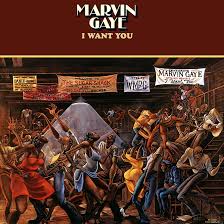 Moving on to some old soul recordings, I listened intently to Marvin Gaye’s sensual, masterfully recorded 1976 album, I Want You [Motown]. Another classic recording here that features the unsung group of Motown musicians known as the Funk Brothers. Despite their excellence on this album, what stands out most for me is Gaye’s vocal overdubs. Thanks, in large part, to hi-rez digital upsamples, DAC advancements, even original recordings sound better than ever. This 1976 recording ripped onto the Memory Player has never felt more alive thanks to designer Mark Porzilli’s continued upgrades. I’m still using the same rip from 1976, yet it continually sounds better and more resolving. The addition of the Tambqui dug even deeper, unearthing Gaye’s genius through its labyrinth of chants, finger snaps, grunts, and groans.
 The joy of enjoying some of my favorite recordings is what listening to high-end audio is all about. However, trying to discern why this particular DAC is more revealing than the others makes reviewing so damn challenging. Only after a few weeks and many hours of listening was I able to discern what was going on better. The Tambaqui’s subtleties are powerfully evident when taken together: its vanishingly low noise floor gives instruments more presence, and a helping hand of harmonics makes for greater realism and authenticity. Easy formula. Harder to achieve.
In short, the less-is-more theory applies. Lowering the noise floor in the way this DAC does – without bleaching out the music – offers a better glimpse that’s much closer to the real thing. The frequency extremes seem to benefit most from this noise reduction. For example, bass drums hit cleaner while the upright bass sounds both quicker and better-pitched. Treble extension goes all the way out into a fading whisper while maintaining the real sense of color, shine, and timbre. Vocals are present and less ghost-like, but at the same time, relaxed and harmonically loaded while remaining afloat in-between the loudspeakers.
In my opinion, the age-old debate of analog versus digital has officially become more fierce thanks to the Mola Mola Tambaqui DAC (teamed up with the Laufer Teknik Memory Player). Working in perfect synergy with a world-class music server in the MP, this combo sounds as undigital as I’ve heard. And I’ve listened to plenty of great digital combos, including the top-of-the-line Aurender and Meitner, just to name but two. The Memory Player was my choice, even against these noteworthy components (using its internal DAC). That said, by direct comparison with the Tambaqui, the MP did not allow me to peer into the music with the same level of resolution it delivers without apology. For the first time in many years of building a respectable downstairs high-end rig, I’ve sat self-secured with the all-in-one Memory Player. Until now! Installing the Mola Mola Tambaqui was the sonic equivalent of an ice-cold slap in the face.
Thanks to modern technology and the growth of the digital medium, CDs have become a thing of the past. Music streamers and digital music servers are the new rave in today’s high-end audio scene. And for a good reason: you don’t even need a music collection anymore. As fast as you can blink, you can connect to millions of songs to almost any genre of music through many different websites. However, this has brought an avalanche of confusion when choosing the best high-end music streamers and DACs available today. The Dutch manufacturer Mola Mola designed perhaps one of the most ambitious stand-alone DACs for a myriad of high-end music streamers entering the market.
The Mola Mola Tambaqui provides a level of excellence that is especially rewarding when you consider it retails for only $13,400. Expensive? Yes, but with the upsurge of external DACs becoming more popular once again, it’s not unusual to see some uber-priced units exceeding $100k. Considering the amalgam of features that come as standard here, the types of in- and out-connections, its 32-Bit DSD DAC chipset with an excellent volume attenuator, it’s going to take hard work to find a better-equipped performer. If you’re in the market for perhaps the best stand-alone DAC available on the market but don’t have $100k to spend, you owe it to yourself to hear what Bruno Putzeys has created for a fraction of the asking price in the Mola Mola Tambaqui DAC. You just may thank me!


clement perry
Specifications:
Price: $13,400
PWM DAC with 32-stage discrete analogue FIR output stage. Avoids “sigma delta” tones and “R2R” glitch and low-level linearity errors.
Asynchronous upsampling to 3.125MHz/32 bit.
7-th order noise shaper clearing 80kHz band.
Each input rate has an optimised upsampling filter chain.
I/O
Optical (Toslink)
S/PDIF (Cinch)
AES/EBU (XLR)
USB type B
Ethernet (Roon)
Bluetooth (A2DP,APTX)
I²S over HDMI
Balanced output
Headphone output (6.3mm Jack, Balanced XLR)
2 programmable trigger outputs
Supported formats
PCM up to 384 kHz /32 bits (>192 kHz and >24 bits only via USB and Ethernet).
DoP up to double speed and Native DSD up to quad speed.
Performance
Full-Scale Output Level: 20dBu.
Signal to Noise Ratio: 130dB.
THD, IMD: not measurable (estimated -140dB).
Bandwidth: Up to 80kHz (apodising response).
Integrated jitter:
Jitter rejection: >80dB at 1Hz after 20 seconds of lock.
KEY FEATURES
OPERATING PRINCIPLE
PWM DAC with 32-stage discrete analogue FIR output stage. Avoids “sigma delta” tones and “R2R” glitch and low-level linearity errors.
Asynchronous upsampling to 3.125MHz/32 bit.
7-th order noise shaper clearing 80kHz band.
Each input rate has an optimized upsampling filter chain.
USA Distributor
GTT Audio and Video
Website: https://gttaudio.com
Email: av@gttaudio.com


Stereo Times Masthead
Publisher/Founder
Clement Perry
Editor
Dave Thomas
Senior Editors
Frank Alles, Mike Girardi, Russell Lichter, Terry London, Moreno Mitchell, Paul Szabady, Bill Wells, Mike Wright, and Stephen Yan,
Current Contributors
David Abramson, Tim Barrall, Dave Allison, Ron Cook, Lewis Dardick, John Hoffman, Dan Secula, Don Shaulis, Greg Simmons, Eric Teh, Greg Voth, Richard Willie, Ed Van Winkle, Rob Dockery, Richard Doron, and Daveed Turek
Site Management Clement Perry
Ad Designer: Martin Perry
Be the first to comment on: Mola Mola Tambaqui DAC by Clement Perry