

Linear Tube Audio Century Monoblock Amplifiers by Don Shaulis
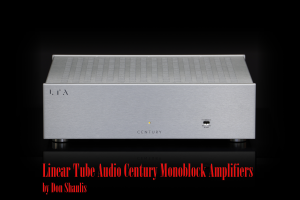
 I have had good experiences with Linear Tube Audio (LTA) products. I currently use their Aero DAC and previously owned a Z10 integrated amplifier. The Z10 was so musical that it was a delight to listen to. I sincerely regret letting it go when I changed speakers and needed more power. I am equally impressed with the Aero DAC. It is the least expensive electronic component in my system by many multiples. Yet the Aero does not embarrass itself in the slightest way.
The Z10 and Aero both incorporate David Berning’s patented ZOTL (Zero hysteresis, Transformer-less Output technology). So when I found out David Berning was collaborating with LTA engineers to build new, more powerful monoblocks to celebrate the company’s tenth anniversary, I was excited. That excitement went up considerably when I also found out they were using Sound Labs as one of the speakers to test the design. I now had great expectations.
Amplifier Design
 Century monoblocks are rated at 110W into 8 Ohms and 144W into 4 Ohms. They overcome complex impedance or capacitive loudspeaker loads by operating at low output impedance and with a wide bandwidth. They are reputed to be stable below 2 Ohms. That is great if you are driving Apogee Scintillas, but Sound Labs pose a different challenge. Because they present a capacitive load, Sound Labs can reach 20 Ohms at 30Hz, with impedance rising to 30 Ohms at 20Hz. Given the factory claims of stability at low impedance and Sound Labs’ high impedance, if the amplifiers perform well with Sound Labs, they should meet their design goal of delivering compelling performance with any loudspeaker design. A front-mounted three-level feedback selector switch further ensures optimum performance with any loudspeaker.
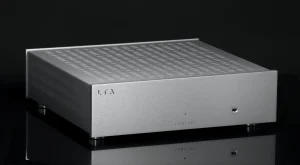
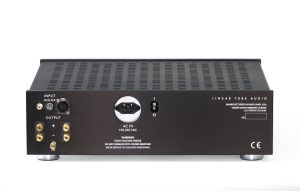
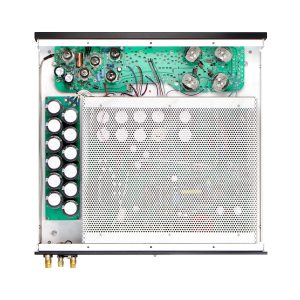
 The amplifiers have additional design features to make them universal. They are auto-biasing and have automatic voltage selection (110-260 VAC). The Century monoblocks have built-in protection circuitry that monitors for overcurrent and DC voltage on the audio output. If the protection circuitry is activated, it shuts off the power supply, and the LED power indicator turns red. This ensures that circuitry or speakers are not damaged in the event of tube failure. The single LED will also appear red during warm-up. After warming up, the LED will turn orange, then fluctuate between orange and green depending on the output level. I never reached the green (higher output) level during my listening sessions. Another example of the amplifiers having power to spare.
There is only one power switch for the amplifiers. It is located at the rear because the amplifiers are designed to remain on all the time. Lower current operation provides improved tube life and lower heat output. Idle power consumption is 100 watts per channel. If the amplifiers have been turned off, LTA recommends an hour of warm-up time before critical listening.
ZOTL Technology
From the LTA website and private correspondence, I learned a lot about ZOTL technology. ZOTL is not a true OTL design. It uses air-core transformers instead of the more common iron-core transformers. Iron-core transformers introduce intermodulation distortion, resulting in a warmer presentation while sacrificing microdetails. In addition to being heavy and expensive, iron-core transformers are difficult to design and entail compromises. The air-core transformer provides the correct turn ratio for speaker impedance matching and is called an impedance converter because it matches the tube’s high impedance to low-impedance speakers. Since the matching is more precise than in an iron-core transformer, the output impedance can be very low, even below 1 Ohm. The low output impedance easily adapts to speakers with complex loads, such as impedance varying with frequency. This is a difficult task for an iron-core transformer amp, including those with multiple impedance taps.
ZOTL technology is a more modern, blended design that overcomes the disadvantages of transformers and traditional OTL amps. True OTL amps typically have more tubes per channel and generate more heat. Century amplifiers use a push-pull design that operates at much higher voltages than a typical tube amp. Half the power tubes are operated at +1500V, and the other half are operated at -1500V. The 3000V swing makes the amplifier very dynamic. LTA claims operating the tubes at one-third the current results in one-third the heat generation and three times the expected tube longevity.

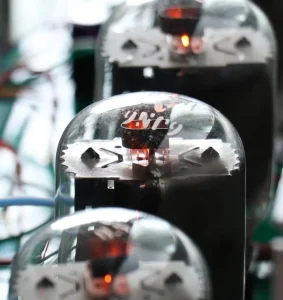
Readers are encouraged to visit LTA’s website for full details of the design. Be sure to click the quick link for information on ZOTL Technology. There is more to the uniqueness of David Berning’s design than I can recount here. From LTA’s website: “For the first time in LTA’s lineup, the Century Monoblocks utilize a screen-driven output stage within the ZOTL topology. EL84 pentodes steer the screen grids of NOS 6JN6 beam power tubes, enabling efficient pentode operation while maintaining the linearity and fluidity associated with triodes.”
More from the LTA website: “Conventional tube amplifiers can struggle with complex impedance or capacitive speaker loads, often leading to shifts in frequency response and diminished control. The Century Monoblocks overcome these limitations with inherently low output impedance and wide bandwidth. Their transformerless architecture eliminates the hysteresis, phase shifts, and frequency-dependent distortions typical of transformer-coupled designs, delivering the speed and grip of transistor electronics while preserving the dimensionality and holographic soundstage that define great tube amplification. The result is effortless authority and control, even with demanding crossovers and full-range panels.” While some conventional amplifiers may seem to work well with complex loads, there is probably an unrecognized performance penalty.
Additional Features
In addition to a reduced heat output compared to other tube amplifiers, the Century monoblocks have several other features I liked. Due to the absence of an iron transformer, each weighs only 26.5 pounds. I cannot count how many other amplifiers did not make my list of “possibles” because of their excessive weight. Each monoblock has a grounding post. I became a true believer in the benefits of grounding after adding a Shunyata ALTAIRA chassis ground hub (review here) and upgrading to Sigma-X grounding cables. All manufacturers should provide grounding posts. I do not bi-wire, but others may enjoy the dual binding posts provided. But be aware that the posts are wired in parallel, and the combined impedance of the connected speakers should not fall below the amplifiers’ impedance.
Performance
 Choice can be wonderful. It can also bring frustration. Using the three feedback levels yielded mixed results. One setting might improve bass performance while the midrange might lose some warmth and body. Spaciousness of the presentation could also change. Depending upon the level of liquid in your glass, this could be a blessing or a curse. The level settings could be very helpful if loudspeakers are swapped. I can also envision users choosing one setting for digital and another for analog or changing the level for different genres. I typically alternated between medium and low feedback. If I played loud rock music, I would choose the normal (high) feedback setting to increase dynamics.
Overall, the Century amps tend toward a leaner presentation. Despite the tube complement, they do not offer the full warmth and midrange body of some, but not all, tube amplifiers. I found my Valve Amplification Company Essence 80 iQ monoblocks to be more holographic and spacious. On the other hand, reduced warmth from the Century amps led to better definition and clarity, especially on low-frequency instruments. Drums, faintly keeping rhythm, became distinct strikes instead of muffled background noise. The Century amps excelled at defining low-frequency information, fulfilling their promise of handling difficult impedance. The choice is obviously system-dependent and subject to personal preferences. The Century monoblocks offer many options for tube swapping, with the first 2 input tubes having the most impact.
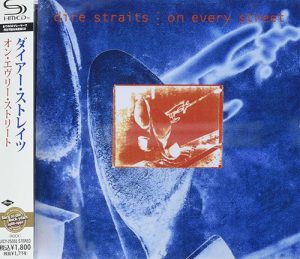 The Dire Straits; CD On Every Street [SHM-CD Universal Japan] is an exceptionally well-recorded CD. The track “Fade to Black” is a classic example where less is more. Mark Knopfler’s voice and the guitars emerge from an absolutely black background. Mark’s voice and the guitars have a hauntingly eerie presence. I heard the same excellent performance on song after song on multiple CDs. If the recording quality had been there, the Century monoblocks would have been superb. There is no need for me to go into multiple examples. However, there was one track that blew me away.
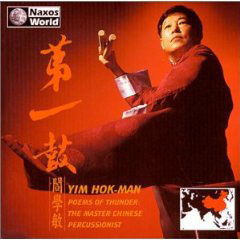 Poems Of Thunder: The Master Chinese Percussionist by Yim Hok-Man [Naxos World 76002-2 DDD] was specifically recorded to capture the impact and dynamics of the taiko drums. It is not an album I would typically listen to in its entirety, but I do like to use the track “Poem of Chinese Drum” for my ultimate drum test. I switched to that track without adjusting the volume to my normal listening level. I about jumped out of my seat with the first impact. I reached for the volume control as fast as I could and turned it down a lot! I feared for my speakers; the impact was so explosive.
Reduced to a more modest but still loud level, the bachi’s impact on the drum head was crisp, and the drum’s reverberation was tight and defined. There was no sloppiness or muffled sound. Except for Sound Labs not going as low as it could, the performance exceeded that of any subwoofer I have heard. Perhaps a large diaphragm more closely represents the large taiko drum heads. And Sound Labs do not suffer from box resonances. Despite the high impedance Sound Labs exhibit at low frequencies, the Century monoblocks had an iron grip and definitely had power to spare. My words here do not adequately describe the visceral impact and quality of the performance.

Version 1.0.0
Let me be clear. I do not consider the Century amplifiers to be bass-heavy. They are bass-accurate and will respond to the recording’s quality. If the recording is well done, the bass will be well defined and not intrude on the vocals or other instruments. By bass, I am referring to all instruments that produce low frequencies, not just drums. On the album Water Falls [Stockfish FSR 357.6025.2], Sara K.’s voice becomes a clear musical instrument, blended yet distinct from the low frequencies produced by the bodhran, fretless bass, and Sara’s signature, specially tuned 4-string guitar. The instruments are portrayed with full harmonic richness and decay, while the vocals are appropriately supported without overpowering them.
Conclusion
Linear Tube Audio Century monoblock amplifiers are detailed, dynamic, and musical, delivering powerful, articulate bass. They reminded me that rated power output is just a number. Amplifier design is critical to how that power is delivered. Century monoblocks handle wide impedance ranges and demanding loads with ease. Several design features allow them to perform exceptionally well with a variety of speaker designs and music genres. They can provide a firm anchor to any system. The versatile Century monoblocks are an excellent choice for users with end-game speakers, as well as those who like to rotate speakers or are still searching for their perfect speaker.

Specifications:
Price: $28,000 per pair
Inputs: XLR and RCA with selector switch. All amplification stages are balanced.
Power Output: 110W into 8 Ω / 144W into 4 Ω (stable below 2 Ω) @ 1% THD
Burst Output: 178W (4 Ω) @ 1% THD, 196W (4 Ω) @ 2% THD
Topology: Fully differential, ZOTL with new Screen Drive and Pentode driver control system
Tubes: (per channel)
4 × NOS 6JN6 Compactron beam power pentodes
2 × EL84 pentode drivers
2 × 7062/E180CC
1 × 12AU7
Construction: Hand-built in Maryland using a dual monoblock chassis, non-magnetic aluminum casework, and full Faraday cage shielding. Available in brushed quicksilver and carbon black.
Adjustable Feedback: Front-panel selector for LOW/MED/NORM (high) settings
Rear panel: Power switch. Grounding post. Dual binding posts to support bi-wiring.
Features: Auto-biasing, automatic voltage selection, built-in protection, low heat output, 3400V peak-to-peak power tube voltage swing, ~ 1 Farad storage capacitance
Frequency Response: 8 Ω: 1.3Hz to 44kHz (LOW), 1.14Hz to 64kHz (MED), 1.3Hz to 90kHz (NORM) 4 Ω: 1.23Hz to 37kHz (LOW), 1.17Hz to 46kHz (MED), 1.3Hz to 58kHz (NORM)
Input Impedance: RCA: 20k (LOW), 26k (MED), 47k (NORM), XLR: 28k (LOW), 36k (MED), 94k (NORM)
Output impedance: 0.8 Ω (NORM), 1.9 Ω (MED), 5.2 Ω (LOW)
Power Requirements: 100-260 VAC, 50-60 Hz, power factor corrected
Weight: 26.5 lbs (12 kg) each
Address:
7316 Carroll Ave.
Takoma Park, MD, 20912
Telephone: 301-448-1534
Email: hifi@lineartubeaudio.com
Website: www.lineartubeaudio.com/
Don’s Associated Equipment
Source Component Wall:
Shunyata Denali-X
Shunyata ALTAIRA chassis hub (CG-NR)
Shunyata SIGMA XC power cord
Shunyata SIGMA-X NR power cords (3)
Shunyata SIGMA-X grounding cables (4)
Aurender N30SA network transport
Linear Tube Audio Aero DAC
Valve Amplification Company (VAC) Master Preamplifier
Shunyata SIGMA-X USB cable
Cardas Clear Beyond 1M & 5.5M XLR cables
Speaker Wall:
Shunyata Typhon T2 with umbilical cord
Shunyata DENALI 6000/S v2 power conditioner
Shunyata SIGMA v2 XC power cord
Shunyata SIGMA-X NR power cords (2)
Shunyata DELTA v2 NR power cords (2)
Shunyata ALPHA v3 and Alpha-X chassis ground cables
Cardas Clear Beyond speaker cables
Linear Tube Audio Century Monoblock amplifiers
VAC Essence 80 iQ monoblocks
Homemade walnut butcher block amplifier stands
IsoAcoustics GAIA II Neo isolation footers with carpet spikes
Yung Long Tiptoe spikes under stands
Sound Lab 545PX speakers
Miscellaneous in Multiple Places:
Symposium Acoustics Svelte and Svelte Plus isolation platforms
Symposium Acoustics Rollerblock Jr. HDSE isolation feet
Finite Elemente Cerabase Slimline isolation feet
IsoAcoustic OREA Isolators
PolyCrystal cable elevators
Homemade walnut cable elevators
Shunyata Research Cable Cradle Wall Plates
Homemade acoustic panels 2’X4’ (7)
Stereo Times Masthead
Publisher/Founder
Clement Perry
Editor
Dave Thomas
Senior Editors
Frank Alles, Mike Girardi, Russell Lichter, Terry London, Moreno Mitchell, Paul Szabady, Bill Wells, Mike Wright, and Stephen Yan,
Current Contributors
David Abramson, Tim Barrall, Dave Allison, Ron Cook, Lewis Dardick, John Hoffman, Dan Secula, Don Shaulis, Greg Simmons, Eric Teh, Greg Voth, Richard Willie, Ed Van Winkle, Rob Dockery, Richard Doron, and Daveed Turek
Site Management Clement Perry
Ad Designer: Martin Perry
Be the first to comment on: Linear Tube Audio Century Monoblock Amplifiers by Don Shaulis