

Dynamic Design Constellation VE Series Cables: Part-2 by Michael Wright
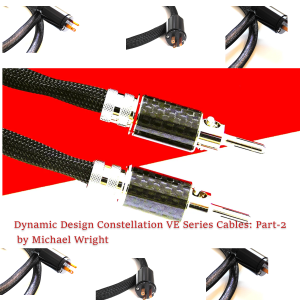
 In this review, I will cover the Dynamic Design Constellation VE interconnect, digital, and speaker cables. I need to mention something regarding the previously reviewed Constellation power cords that affects this review. About 8-9 months after my Constellation power cords review, Olu Sonuga, Dynamic Designs’ Chief Designer, and I were discussing the direction of audio, future Dynamic Design products, and how far things had come from earlier designs. Nothing earthshaking, just a couple of audiophile types talking about audio. Interestingly, Olu felt I had not shown as much enthusiasm for the Constellation power cords as he thought I would (reviewed here). I shared with him that I thought I had been honest about what I thought and what I had heard. Also, based on the listening sessions I had with friends and the constant back-and-forth in the listening process, comparing the Constellation power cords to everything I had in-house, I didn’t give Olu’s comments any more thought. Besides, most manufacturers believe they make the best-sounding, best-made products, and they should. I’ve come to accept it as part of the review process.
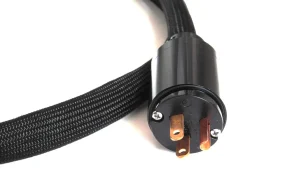
A month or so later, I was talking to a good friend who lives for system setup and enhancement and wanted to run some ideas by me on where to place my Inakustik 3500P conditioner in the system to get the biggest bang for the buck. After a couple of discussions about the application, I concluded that plugging my amplifiers into Inakustik would best serve my system. When I made this change, I was astounded by the improvement it brought. The sound became more expansive, with extended highs, greater dynamics, and a much darker background. After listening to my system like this, I thought back to Olu’s words about my “seeming lack of enthusiasm” for the Constellation power cords. I liked his power cords a lot, so I wasn’t sure what he meant, but decided to put a Constellation power cord on the Inakustik since it was now in a different position in my system. I was not prepared for the significant improvement in my system’s sonic performance that the change brought. My very initial thoughts were, “What just happened?! This Constellation power cord isn’t supposed to sound THIS good. How could I have missed this?” I always felt that the Constellation power cord sounded very good. Still, it now sounds much, much closer to my Dynamic Design Heritage power cord, which was not only my best power cord but also one of the better-sounding power cords I had listened to and compared to some cords from Shunyata, Nordost, and Cardas, amongst other references I had owned. There were slight increases in detail and focus. Still, I heard very noticeable improvements in dimensionality, the ebb and flow of the music, particularly in orchestral pieces, and a more natural, organic sound in the music I was listening to. What really stood out to me was the power, extension, and control at the low end.
 I was caught off guard by the noticeable increase in bass performance. I was both excited and thrilled to hear what the Constellation power cords could do in my revised system setup. Still, I was not looking forward to having to re-evaluate what I had said about the power cords in my initial Constellation review, and I thought back to what Olu had mentioned about my seeming lack of enthusiasm for his power cord. I concluded that he may have been right, and that, out of fairness, I should listen to the Constellation power cords in different parts of my system, which I did. My comments and remarks regarding the Dynamic Design signal cables were made with the Constellation power cords throughout my system: on a single VAC 200 iQ run in stereo, my VAC Renaissance preamp, the Holo May Kitsune DAC, and my Marantz and ARC CDT1 CD players. The Constellation power cords consistently delivered the same increased performance as when I used them with the Inakustik. Regarding power cords, I have reached two important conclusions. First, make sure your conditioner(s), if you’re using them, are placed in the system optimally. Second, don’t skimp on your power cords, as they can be a vital part of your system.
Technically Speaking
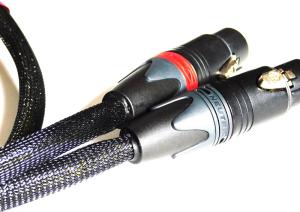
The Dynamic Design Constellation signal cords are like other Dynamic Design offerings. They are extremely well made, use some of the best wire and parts available, and are beautiful to look at. Olu is a craftsman when it comes to constructing cables and matching parts. If something doesn’t meet his exacting standards, he boxes it up and stores it away. On more than one occasion, I told him I would gladly take his rejections off his hands and be totally happy with them. If you recall his Lotus line of cables, the Constellation interconnect and speaker cables are like that, but slightly bigger and with a more eye-catching, deeper black. The interconnects are terminated with RCA or XLR connectors, and the digital cables are available in S/PDIF or AES3 configurations. An even more pleasant surprise was the speaker cables. They are about the same thickness as the interconnect and are just about as pliable and easy to configure in your system between amps and speakers. They also come in separate runs of negative/positive for your speakers, meaning you’ll get two cables for each speaker. Olu sent two pairs of review speaker cables, one with spades and one with expandable bananas, so that I could bi-wire my speakers. The speaker cables were finished with a black jacket, a first for me, and were very attractive. If you have any questions for Olu regarding impedances, why he chooses the parts he does, or his cables, he invites you to email him (www.dynamicdesignav.com). He will respond to your inquiries as time allows.
How The Constellation Cables Sound
One of the things I have always appreciated about Dynamic Design’s marketing philosophy is its trickle-down philosophy. Every time they improve one of their more established or upper-end cables, the technology in that cable will trickle down to some of the less expensive cables, making them even better-sounding than before the improvement.
I started out listening with a long run of Constellation interconnect between my VAC Renaissance preamp and my VAC 200 iQ amplifiers, using one as a stereo amp for a week and then using both 200 iQ amps run in mono for a couple of weeks, to get a feel for what the cables could do with tubes. A month or so later, I switched over to my Bully Sound Company solid-state Class-A mono-amps to get a different perspective on the Constellation’s performance across different genres of amps.
The Constellation interconnect and speaker cables are very natural-sounding sonically, with a lot of musical information passing through them, but not a bit of etch. I tend to think musical detail gets overrated when evaluating cables, since any good cable should deliver it. It’s the cables that are missing the details, or items in the music, you know, that should be there that you should be wary of. I tend to focus more on the separation of instruments and performers in something with a reasonable semblance of a soundstage. When listening to orchestral music, I want to hear and follow the different sections of the orchestra. If it’s a good recording, when things get loud, I want to be still able to follow the different musicians on stage or separate orchestral lines. The Constellation cables deliver everything I like to hear in music and much more. There’s plenty of micro- and macro-detail for you fans, but the musicality and the sense of ease with which it passes the signal along caught my attention even more. Instruments and vocals sounded real and honest. Albums recorded with a heavy electronic influence sounded different from analog recordings, both enjoyable, depending on which you prefer. I never felt like the Constellation cables preferred one over the other. Like all Dynamic Designs cables, the Constellation cables are wide-bandwidth designs that let all the music recorded come through as the engineer recorded it, so you can hear all the tonal colors and nuances, no matter how small or big they might be. My Tekton Moabs can play loud and handle dynamics, high-impact sounds, and bass very well. The Constellation cables have given me some of the loudest high-energy brass sounds and some of the deepest, authoritative, room-shaking bass that I have had in my listening room. I have had cables deliver bass as deep as the Constellation’s, but not with the same authority.
Certain items that I look for to vibrate flat-out rattled in my room. The delicate nature of certain instruments, such as flutes and harps, helps maintain their soft shimmer and airiness. Classical guitars have that intimate finger-plucking, with a type of music that will be reproduced in my system based on fit and finish, a soft, resonant sound, and lutes. In some classical music, a plucked, resonant sound. Another strength of the Constellation cables is their ability to replicate transient response. The initial transient of a plucked string or the attack of a hammer on the piano cords is distinct and clear, as is the decay when instrumentalists allow notes to linger for effect. I was especially impressed with the Constellation speaker cable, as it goes a long way towards proving that you don’t need the thick, stiff, behemoth cables some manufacturers are marketing. The sound from these speaker cables was commanding and powerful, as in blues, rock, and reggae, yet also capable of conveying music that was sweet, delicate, and engaging, such as lullabies, chamber music, and love songs. Equally as skillful in handling music were the Constellation digital cables, both of which sounded excellent and compared favorably with my Pink Faun digital cables. After they locked into my DAC, the music flowed beautifully and sounded beautiful. I have tried or listened to lower-end digital cables, and it’s easy to tell where the shortcomings in the music are. Both the S/PDIF and AES3 digital cables perform like top-notch digital cables, and I could happily live with either, though I might give the balanced-connector cable a slight edge. There were times when I felt the single-ended S/PDIF cable sounded better. The differences were very slight, but the musical enjoyment with both was abundant.
 On Cecile McLorin Salvant’s album WomanChild, tracks such as “I Didn’t Know What Time It Was”, which sounds like one of the ballads of the time, “Nobody”, slips back and forth between an Ella Fitzgerald type of ballad to pure ragtime, and “WomanChild” is straight ahead jazz and demonstrates the Constellations honesty to the music as all 3 songs have three distinctive playing and singing styles. I felt “WomanChild” was the most revealing of the three selections, as Ms. Savant is playing with a band in which the bass, piano, and bass lay down a solid foundation for the music to follow. Really, the whole album is good if you haven’t listened to it. Zamajobe’s album Ndawo Yami was another source of female vocals I listened to for this review. The track “Come With Me” is a lovely, mellow little track that highlights the sweetness in Ms. Zamajobe’s voice, and it also features a nice, understated guitar track that the Constellation allows me to hear all the finer details of the two guitars being picked and strummed. On Sam Vloemans’ South American-tinged jazz album Bord du nord, the track “When She Slept” had a nice bass line that was tuneful and easy to follow, as was Mr. Vloemans’ horn. The track “Zomer Riedel” was a bit frenetic, but the accordion playing lead could have added to the sonic frenzy. Still, the separation of instruments with the Constellation was great and made things easy to follow. Two other tracks were musically involving: “End of the Night” and “Late Night Groove”. On the B.B. King/Eric Clapton collaboration Riding With The King, the classic “Three O’Clock Blues”, listening to the contrast in guitar playing styles between Mr. King and Mr. Clapton never gets old. Not only does the Constellation do a good job highlighting the two guitars talking to us as they’re being played, but you can also easily follow the piano and organ, both playing supporting roles in the background. On Charles Lloyd’s The Water is Wide, the Constellation cables did an exemplary job portraying the tone and timbre of My. Lloyd’s saxophone particularly on tracks “The Water is Wide”, “Black Butterfly,” and “Lotus Blossom”. Really, another one for the “the whole album is nice” category.
A Few More Thoughts
 I must mention here that I spent an enormous amount of time going back and forth between the Constellation single-ended and balanced interconnects. I can honestly say I didn’t prefer one over the other. After some nights of listening, I was truly a “dyed in the wool” balanced interconnect cable fan, but then, a week or two later, I was picking the single-ended in the blind listening tests I would do with my friends. I reached the same conclusion about the two digital interconnect cables. Both the S/PDIF and AES3 sounded good, and you couldn’t go wrong with either. I think it would be close enough that prospective listeners would have to go with what they have their system set up for, single-ended or balanced. Either way, you would be getting a wonderful cable. One other item of note was that I also had a single-ended pair of interconnects on the turntable tonearm to the phono section of my VAC preamp, and that performed amazingly. That sense of ease and naturalness translated well to both my Merrill turntable and my brother’s very excellent S.A.M. Aldebaran turntable.
I thoroughly enjoyed my time with the Constellation cables, not just the power cords, but with the interconnects, digital cables, and speaker cables. I’m still amazed every time I look at the interconnect cables and how closely they resemble the Lotus cables of old, yet sound so much better than they did. Sometimes I play this game and try to figure out which of the Dynamic Design cables I’ve heard of and wish I could afford, and now find these cables much more affordable than in times past. What’s even more remarkable is that, as good as these cables sound, Olu informs me that the Constellation line I have been listening to is superseded by the cable lines above it, e.g., the Titania and Heritage lines. I have a Heritage power cord and a pair of interconnects, and even those have been improved upon. Those cables are already outstanding and serve as my reference, so it’s hard to wrap my head around that. The Dynamic Design Constellation VE interconnect, digital, and speaker cables receive my “Most Highly Recommended” recommendation.

Dynamic Design Constellation VE Cables
Constellation VE Speaker Cables w/Bananas 2.5M – $5K
Constellation VE Speaker Cables w/Spades 2.5M – $5K
Constellation VE Interconnects XLR 1.5M – $3K
Constellation VE Interconnects XLR 7.0M – $8.5K
Constellation VE Interconnect RCA 1.5M – $3K
Constellation VE Digital Interconnect S/PDIF 1.0M – $1.5K
Constellation VE Digital Interconnect AES/EBU 1.0M – $1.5K
Manufacturer: Dynamic Design AV
Website: www.dynamicdesignav.com
Contact: mail@dynamicdesignav.com
Mike Wright’s Associated Equipment:
Speakers
Tekton Design Moabs
Amplifier
VAC Signature 200 iQ Amplifiers (used as stereo and mono-amps)
BSC Audio BSC100m 100-Watt Mono-amps
Preamplifier
VAC Renaissance Mk V with Phono
Analog
Merrill Heirloom Turntable
Rowland Research Consonance Tonearm
Transfiguration Phoenix Cartridge
Digital
Asus Laptop w/Fidelizer Pro, Roon, and JRiver v.26 for Hi-Res Files
Holo May Kitsune III DAC
Bricasti M5
Marantz SA-7S1 CD Player
Cables
Dynamic Design TBK Nebula RCA Interconnects
Dynamic Design TBK Nebula Speaker Cables
Dynamic Design Heritage AE15 Balanced Interconnect
Dynamic Design Heritage AE15 Power Cord
Dynamic Design PAAPI Interconnects
Dynamic Design THB Nebula AES3 Digital Cable
Silversmith Fidelium Speaker Cable
Pink Faun – USB Digital Cable
Pink Faun – RCA Digital Cable
AnnaLyric Silver Power Cords
AnnaLyric Pathway Digital Power Cord
Essential Sound Product Essence II Power Cords
Power Line Conditioner
Inakustik 3500P
Pulizzi Engineering Z-Line
Essential Sound Products Essence Power Distributor
Accessories
Star Sound Apprentice & Rhythm Platforms – for amps
Star Sound Sistrum Rhythm Two Platform Stand
Symposium Acoustics Ultra Platform
Symposium Acoustics HDSE Rollerblocks
Symposium Acoustics +2 Rollerblocks
Adona GX4 Equipment Stand
Epiphany Stand Systems – Celeste Reference Stand


Stereo Times Masthead
Publisher/Founder
Clement Perry
Editor
Dave Thomas
Senior Editors
Frank Alles, Mike Girardi, Russell Lichter, Terry London, Moreno Mitchell, Paul Szabady, Bill Wells, Mike Wright, and Stephen Yan,
Current Contributors
David Abramson, Tim Barrall, Dave Allison, Ron Cook, Lewis Dardick, John Hoffman, Dan Secula, Don Shaulis, Greg Simmons, Eric Teh, Greg Voth, Richard Willie, Ed Van Winkle, Rob Dockery, Richard Doron, and Daveed Turek
Site Management Clement Perry
Ad Designer: Martin Perry
Be the first to comment on: Dynamic Design Constellation VE Series Cables: Part-2 by Michael Wright