

The Lejonklou Boazu 2.0 integrated amplifier by Dave Abramson
 A Solid State
When I started my Lejonklou journey some years ago, I was a bona fide solid-stater. Tubes were ‘a hassle, ‘expensive, and ‘old technology.’ They made only brief cameos in my home in a dac or a preamp or a headphone amp (Earmax anyone?). Turns out all of these things are true. They are old technology, certainly expensive, and, at times, a hassle.
In the ‘in between’ times, they sound better. I now understand and have been admitted to the club. Here here! Hail fellow, well met!! To my ear indeed, such trifling devices are not just ‘warmer’, they are more tonally saturated, more vividly human. Yeah, tonal saturation is their thing. Density is their thing. Space and air are also their thing(s), and yeah, with an awfully big and awfully stiff power supply (ah, Harvey Gizmo Rosenberg, we miss you!!), even raw punch n’ power is their thing. I’ll afford you solid-state can sort of do a lot of this good stuff now, too, but it has to be very good solid-state indeed. Even at that, it’s not nearly as retro-cool on your rack.
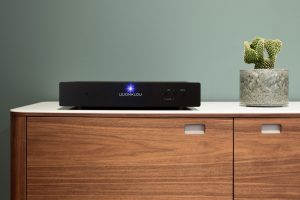
If thermionic repair bills aren’t your bag and the never-ending hunt for a rarified Mullard or Brimar doesn’t make your internal 211 or 845-driven heart skip a sine wave, I bring good news for you in the form of a non-thermionic, unassumingly squat black box.
I can share that I’ve reviewed, owned, and esteemed a succession of Lejonklou amplifiers, and they are just that: very good, solid-state (in unassuming, squat black boxes). The kind of solid-state that could give a tube guy pause, long enough to finish at least two tracks on ‘The Look of Love’ instead of one. Yes, Boazu 1.3 (and later 1.5) did so many things so very, very well for me; pace, timing, delicacy, and staging, to name a few—a deathly silent background to name another.
But as I acquired the above-mentioned taste for tubes and heard and lived with an increasing number of Lebens, Air Tights, Shindos and Aurorasounds, I ‘came to find’ (Doug McLeod reference!) Boazu 1.x did the delicacy and some of the space those amps do, but lacked maybe some of the separation, colors, and even the ‘punch’ of some of those amps (yes! even of some of the 10 watters like my Shindo Cortese F2A; after like a two-hour warm up, of course!). What’s more, some of these amps, like my Air Tight ATM-1S with its super high-quality Hashimoto transformers, set the musicians upon an even blacker background. That one was a shocker.
Moreover, Boazu bass, while refined tonally, was a touch polite and ‘correct’ instead of big and generous. In retrospect, Boazu also lacked some of the nuanced tonal vividness up and down the scale of those great tube amps, sounding even a bit ‘bland’ or uninteresting, but only by comparison.
No sane audiophile (wait…what!?) would ever hear a Lejonklou product and call it “uninteresting.” Visually? Sure. It’s a black box after all. Sonically? Never. Too much going on musically for that.
I think Bob Dylan explained the situation very aptly when he sang:
“Louise, she’s all right, she’s just near
She’s delicate and seems like the mirror
But she just makes it all too concise and too clear
That Johanna isn’t here…”
 And so, just as Boazu had become my Johanna, replacing the Louise that was my Wells Majestic integrated, so too did I gradually replace Boazu 1.5 in rotation with my increasingly finicky and exotic tube amps. To wit, my new Devore 0/96’s really allowed some of these low-watters to strut their low-watter type stuff (but only after like a year or more of trying to set them up correctly. What was that about ‘sane’ audiophiles?!) Oyyy… but that’s for another day.
And now there’s Boazu 2.0; a solid stater among the 300 B’s, EL-34’s, and F2A’s in my current stable of thermionic horses. A squirrel among foxes. How will she ride?
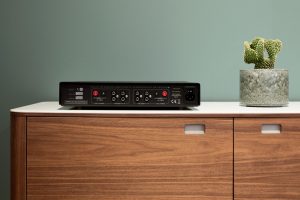
Visions of Boazu (2.0)
Thanks to the internet, I didn’t even have to ask Lejonklou distributor and renowned LP-12 turntable whisperer Tom at Nokturne Audio what the big deal was about the 2.0 upgrade. Finally! A use for the internet that does not involve cat videos! I know! As far as sonics go, in classic Tom pocket-protector-and-slide-rule understatement, he said something along the lines of ‘it seems to be a somewhat significant step up’.
In a Lejonklou forum post (yes, they have one and yes it’s lively and unusually respectful), Fredrik Lejonklou himself laid bare the differences between Boazus 1.x and 2.0. So I don’t screw it up and sound like I know exactly what questions to ask him on my imaginary future audio podcast, I am quoting the following (edited somewhat in the interest of brevity) directly from a Lejonklou forum post by the forum’s namesake himself, one Fredrik Lejonklou. He writes: “Everything is now made in Sweden (apart from the electronic components) [and] the advantages are many. The main one is that I have intimate communication with and immediate access to the assembly (one hour away by car), so we can sort out difficulties and improve how things are done. Several techniques used are also of higher quality and require a redesign of the main board.”
“The new case (also made in Sweden) has more ventilation and sounds better (mainly due to the integral pillars that support power supplies and the main board). The inductors in the preamp section have been [upgraded]. The internal cabling has been [upgraded]. The inner layers of the circuit board have been optimized for capacitive coupling between layers. This is something I hadn’t mastered in 2016 and takes a long time to evaluate. Basically, it’s a tradeoff between low impedance and unwanted capacitive coupling.
Selection of all components is more optimal, partly thanks to my soon-to-be employee Oscar, who has measured an enormous amount of components and selected them into small groups.”
We briefly interrupt this Fredrik quote to give Oscar his flowers, as the kids say. This man certainly does NOT have ADHD and does a job that well… I certainly could not! Fredrik continues, “On the original Boazu, I used all the selections that were left after making Tundra (stereo amp) and Tundra mono, but on Boazu 2, I decided to use the best selection of many parts.”
“Idling currents are a bit higher than in the original Boazu, which sounds better. This is fine-tuned for each unit, which can sometimes take hours because it involves changing components until optimal values are obtained. The feedback loop has been fine-tuned to a precision of 0.1 Ohm and 1 pF. In the original Boazu the precision of the resistive part of the loop was 1% and now it’s 0.0005%. This may seem over the top but it does nail down the ‘pace’ of the amplifier more precisely.” Dear and gentle reader, take heed of Fredrik’s words! I believe this is exactly what I heard in the 2.0 amp, but of course, one can’t say this somewhat more tuneful/pacier presentation is down to the “precision of the resistive parts loop,” or can one? Fredrik can and did.
To wit, he goes on to add that “It’s one of those parameters that can easily be heard in the music and that appears to have no limit when you gradually increase the precision. Each time we tested one tenth of the previous precision, the musical differences were about as big as in the previous comparison.” Finally, “RCA connectors now have gold-plated barrels and tin-plated signal parts. Original Boazu had nickel/nickel because they were much less expensive than the gold/gold model I use on all other units (which appears simple and standard in its design but is quite expensive).”
“Instead of changing to the gold/gold model, I found this new RCA to be more musical than the nickel/nickel one and very close to the gold/gold model. The IR receiver on the front panel (now on the right side next to the buttons) is a little more sensitive than the version used on the original Boazu. Output transistors now have the same phase-shift thermal interface material and the cooling arrangement with a spring-loaded copper clamp as Tundra Mono 3.” So too the “Chassis ground is now of the new and better sounding type. It first came with Källa (streamer) and was gradually upgraded on all other units.” Of note, this new ground is clearly important at Lejonklou, as it was also the main sonic upgrade that made the Boazu 1.3 into a 1.5.
Alas, current Boazu owners, if precision loops and grounding schemes are making you salivate (hopefully not near the stereo rack!!), the last paragraph he left us with will indeed be an unfortunate one. It even begins with ‘unfortunately’…
“Unfortunately, due to all of the above noted technical changes, Boazu of 1.x varieties are not upgradeable to current 2.0 spec.”
Take heart, though, in that the ‘legacy’ Boazu 1.x does not in any way suck and is a great, sturdy acquisition/jumping-off point into the whole Lejonklou sonic ethos.
Whining about Wiring
 As revealing and emotionally sensitive devices, the Lejonklou amps are among the most wire-sensitive in my experience. [Warning: objectivists, especially those who own and operate oscilloscopes and noted regulars on Audio Science Review, look away now! You have been warned, and this means, per the Stereotimes crack white-shoe legal team, your therapy bills are now no longer Stereotimes’ legal responsibility!]
The recommended wires for a Lejonklou amp, and any Lejonklou amp, are as follows: 2.48-meter lengths of Linn K200 (literally take a sharp instrument and split the older black-jacketed bi-wire Linn K400 into two separate speaker cables; one for each channel). You can also purchase the current Linn K200 cables, which, depending on whom you ask, may or may not be similarly musical.
Men of Lejonklou (MOL) also highly recommend and endorse Linn Silver interconnects. Any vintage will do, but the most sought-after are the older versions of Linn Silver, which used non-slotted/solid RCA barrels (you can search pics to see the difference between the older wires and the newer ‘slotted’ ones).
Hear ye, hear ye! I am about to speak heresy! I am not as much a fan of Linn Silver as my Lejonklou brethren. I am a BIG fan of a curveball here, the Grimm TPR. There. I said it, and I feel better. To my ear, more even tonally, more spacious, generally perturbs the signal less, generally less present as a wire. Quick!! To the Pyres! Burn the witch!!!! I know. I know.
In head-to-head comparisons with Boazu 2.0, though, comparisons in which I duct taped my eyes shut (I kid; I kiiiid! They were utterly useless sighted comparisons from which no solid conclusion can be drawn), I preferred the Grimm TPR interconnects every single time. I felt they maintained all the pace and punch of the Linn silver while revealing better tonal color, more space, and lending an overall more natural feel to the proceedings. In fact, I’d say the Grimm TPR cables really showed me the full measure of Boazu 2.0’s considerable capabilities, and without them, my system would be the poorer for it. They work beautifully with my Air Tight amps as well.
Now how’s this?! I even had them made into Shindo-compatible interconnects (those use Switchcraft RCA connectors and are grounded at the preamp end) for ‘safe’ use with my Shindo system, and they present a viable alternative to the vaunted, though unobtainium, Shindo ICs I also possess. They are a bit less lit up than the silver Shindo IC, hence requiring careful tuning with appropriate speaker cables so as not to overly warm up the soup, but once sorted (say with a pair of more articulate Luna cable Mauve speaker cables), it’s a fine alternative IC overall. I’ve always felt Shindo ICs worked best with Shindo electronics, and I’ve had very limited success using them outside their native ecosystem.
The best part? That will be 100 dollars for one meter of Grimm TPR, please; not several hundred or several hundred thousand! And you can specify your favorite connector (I believe Grimm is partial to the Amphenol RCA). Proaudiola.com has them if you don’t have a local Grimm dealer. The Grimm interconnects have truly improved my audio life, and I love them. They are my current ‘go to’ ICs for Everything (except perhaps Shindo, where the Shindo ICs and A23 work sympathetically). I utilize the recommended Amphenol connectors with the Boazu and the Switchcraft terminated cables with amps like the Shindo (so I don’t damage the RCA connectors on the amp or preamp).
I do have the split K400 for speaker cables. Yes, in the exactly specified and directed 2.48 meter length. I’m not a heathen!! And these are weightier, more tonally beautiful, and more nuanced than the Linn K20 (aka Naim NACA 4), which I also like with Lejonklou gear.
The k20 (super cheap!) and the k200 will both show you that you don’t need to spend lavishly on cables for certain amps, as long as what you’re using is sonically copacetic with said amp. The pairing of Linn cables and Lejonklou amps is most certainly copacetic. I would say, though, that while K20 is fast and fun, it lacks the tonal nuance of K200. And K200, while more nuanced and weightier, may be a bit mid-bass heavy for some systems. She’s a weighty-sounding piece of wire, that one!
To wit, I have an audio buddy, Rod, who is a whiz with cables and isolators, etc., and he uses some of his proprietary isolators under his Boazu 1.5 to lighten the tone a touch when using the K200 speaker cables. He (and I) have also experimented with various power cords such as Siltech and Acoustic Revive, and you can certainly hear the tonal shifts and variances they engender. Are they ‘better’ than the stock super dinky ‘Mickey Mouse’ 25 dollar power cable? Well, they are indeed different.
Other reviewers with other ears and/or other civilian listeners have had good success with other brands of speaker cable (Kirmuss, for example), so, as always, your mileage may vary…
Listenings
 I am not sure Fredrik Lejonklou will like what I am about to say. Maybe it was not at all his design goal. No matter. I’ve never met the man, so I can hide behind my keyboard and screen and say what I will until I do. I also work out regularly and have taken at least two months of Brazilian jiu-jitsu, so I’m ready! (Damn, that’s an expensive and overly complicated way to feel ‘safer,’ and I’m not sure I do!) Seriously, I’m excited. Very excited! The Lejonklou Boazu 2.0 sounds a lot like a legendary Japanese tube amp. Nobody said this on a forum, and I didn’t hear it from my friend or third-hand from a friend of a friend.
I have three legendary Japanese tube amps sitting right next to it on my rack (see pics); a Shindo Cortese F2a with matching Shindo Monbrison preamp fully cabled with Shindo silver cables and Auditorium A23 speaker wire, an Air Tight ATM-1S El34 amp with full set of expensive NOS RFT Telefunken tubes as well as a pair of Siemens 12AU7’s singing to my satisfaction and a late arrival to the party is an Airtight ATM 300R with its massive Tamura transformers and NOS tubes now including a Westinghouse rectifier, Amperex 7316 12AU7’s and 1960’s RHB3’s. Moreover, I’ve heard Takatsuki and Western Electric 300 B’s in it. In fact, they are in boxes in my kitchen as we speak (type?).
They aren’t in the amp because so far I’m preferring (get ready- another inexpensive hot tip!!) the Linlai Sapphire 300B from Amazon… I mean China! Yes! Available on Amazon for like 200 bucks a pair- not 2000! And yes- currently I prefer their quiet neutrality to what I hear as excessive warmth in the westerns or to a lesser degree, the vaunted Taks. A few grand saved, fortunately! Those amps aren’t cheap, and I’m not Jason Victor Serinus (does ANY man on earth know what that guy does for a living?? Step forward and speak up now!! Jeez! The isolators for his rack cost more than my entire system! Oh well– next life).
Chinese tubes or legendary Japanese tubes, I’m telling you the Boazu 2.0 is right there with all of them in many ways that matter. In fact, if Amir from ASR broke into my house, planning to steal my non-linear, unmusical tube amps and blindfold (duct-tape?) me at solder-gun point in the process, telling me the Air Tight ATM-1S was playing. It was really the Lejonklou Boazu 2.0 all along, well —I’m not so sure I’d be able to tell you it wasn’t so! That’s damn good. The Boazu 2.0 is fast, mega-fast (maybe even faster than some tube amps?), punchy, and, importantly, almost (but not quite) as tonally colorful. It is lit up, holographic, and spacious like the tube amps, though, to be fair, it just misses their intensity and contrast. Like them, it too is slightly to the warm side of the force. It really does seem, at times, to blend some of Shindo’s hallmark relaxed spaciousness with the Air Tight muscularity and punch. I was absolutely not expecting this. Absolutely not.
I was expecting merely a ‘bit better’ 1.5; sort of a 1.6 if you will.
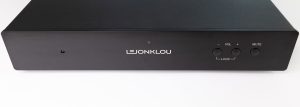
I mean, the 1.5 was (is!) very good! Very, very good! But the 1.5 is very definitely not the 2.0. And as soon as you fire it up (more dramatic-sounding than it is in practice with a Boazu), really, you don’t need the now-subtler front logo (awesome understated touch!) to tell the difference; it was immediately sonically apparent.
The 1.5 is, by comparison, a touch sweet and delicate; leading edges are a bit smoother, and the tone is slightly prettified. As Rod showed me at my place, this can be ameliorated to some degree with careful wire selection. You can make it punchier and more aggressive. Essentially, there are some hallmarks of the refined tube amplifiers sitting right next to it on my Box Furniture modular rack. The 1.5 stages beautifully, particularly laterally, with excellent resolution of fine detail. The bass is more toward the pitch-accurate end of the spectrum than plethoric, and the mid-bass is tight and punchy when the recording has it to offer. The amp’s PRaT, of course, its ‘tunefulness,’ a Lejonklou design specialty, is on point.
With the 2.0, even at low levels, your foot starts tapping, and you are taken by the pace of whatever you’re playing; sometimes even if I wasn’t a fan of what was playing! The only other amps that had this kind of ‘mad PRaT’ in my experience were my Naits, the 2 and 3 I had years ago. But those amps sure didn’t have the 2.0’s tone, and their portrayal suffered a bit of ‘realism deficit’ as a result. No, those legendary amps weren’t the complete amps the Boazu 2.0 is, and to my ear, they didn’t sound quite as lifelike or as fleshed out. More recent Naim amps I’ve owned, like the Supernait 3 and the XS 3, were better tonally than the Nait 2 and 3, but at the expense of some of the PRaT they had.
I feel the Boazu 2.0 is among the first amps I’ve heard that combines the best of Naim PRaT with improved tone, taking it beyond the ‘newer’ Naim integrateds I’ve had in that regard. No easy feat! I particularly loved the Nait XS 3, even compared with the Boazu 1.3, and at times preferred it. But the Boazu 2.0? Yeah, aural memory is a cold witch, but I think it’s better than my XS 3 was in essentially every area. Now returning to my crop of tube amps, I think I’m saying that the 1.5 (which, as I type, I still have on hand here) may have ‘suggested’ these exotic space heaters, but the 2.0 may have just done it, or really almost done it. It gets closer, sounding bigger in the process.
I think the real sonic key here is ‘delicacy without being delicate.’ Maybe I should call it refinement, but with punch. Yes. That’s what I mean, and that’s exactly what Boazu 2.0 offers. There is a certain delicacy and beauty in the (legendary) tube amps I have here, and the 1.5 had that beauty and delicacy perhaps to a fault. The 2.0 corrects this a bit in the other direction and therefore seems to achieve a more realistic balance between tonal beauty/delicacy and clarity while exceeding the PRaT, or “tunefulness,” of its elder. It’s a bit fuller, weightier to my ear; maybe a bigger one in terms of presentation, with more punch as well. In fact, this seemed evident even in some videos posted to the Lejonklou forum that I saw, in which Fredrik recorded both the 1.3 and the 2.0 playing the same song. You could hear, even over the interwebs in Fredrik’s test lab, that the 2.0 was somehow a bigger, bolder sound than the 1.3 it was trading blows with. That stayed true to form in my home. Here are those links:
The 1.3: https://lejonklou.com/B13.MOV
The 2.0: https://lejonklou.com/B20.MOV
Essentially, that makes the Boazu 2.0 almost, but not quite, a no-fuss, no-feature Japanese tube amp with no tubes and no storied Japanese heritage. (Maybe if Naim made a tube-integrated, this is what it would sound like?) Yeah- that’s it!)
Well, actually that last 5-10 percent is a doosey. The last bit of space, air, and elasticity of these great tube amps, we are not quite there. Yes, the 300R, the specially tubed Air Tight ATM-1S, and the Shindo F2a are slightly more ‘interesting’ and nuanced tonally. The 300R in particular is a monster in terms of bass and has superb resolution, and the ‘flow’ of the Shindo sound really is a Saturday morning Mimosa vibe, but you have to like that vibe. (You can’t be Jay of Jay’s Audio Lab– he would NOT be a Saturday morning Mimosa guy). I guess what I’m saying is my tube amps have more interesting and nuanced ‘personalities’ for better and worse than the Boazu 2.0, which quietly gets on with the day-to-day reproduction of music sans any drama (‘cept that which appears in the music itself). If this were the 1930’s, I’d say my tube amps have more Pizazz or sound ‘jazzier’. You take my meaning.
What of it, Zen?
 Very much like my other amps, Boazu 2.0 is hand-built in a small (but tidy) workshop, lit by the pallid Autumnal moon as the cherry blossoms blow in the lengthening shadows of Mt. Fuji… (ok, I made all that up). It isn’t authored by anyone named Ken-san or Atsushi-san ‘neath Mt. Fuji’s shadows. Instead, it’s just ‘plain old’ Fredrik (sans ‘san’) and now featuring Oscar (also non-san).
Yeah, the Boazu 2.0 is not a Japanese tube amp, but it is now proudly and more than ever Swedish. It is a black box with a newer, more subtle label, as if it’s almost trying to retreat incrementally more from its own physical presence into the recesses of your rack. It is always on yet gives off barely any heat. It has no input switching, which means if you connect a streamer and a CD player and push play on both, both will play through it at the same time! It is less than half the price of any of the amps it sits among on my rack. It has never been back to the distributor for repairs, not even once. It is my new solid-state reference; a cheshire cat with a wry smile amongst the pigeons (peacocks?).
IMHO…
Like its new ‘subtler’ front label, Boazu 2.0 is aesthetically and musically self-effacing but never to a fault. Rather, it allows just enough of an impression of itself upon the proceedings to let one come away after a hearing with the distinct notion it’s among the most refined and engaging solid state you’ve experienced. Minimalist’s dream. Eminently musical. Fuss-free and electrically silent. No features. What should I say? Depends on what you value. But this latest creation from the mind of Fredrik is, as always, all of those things and somehow more. Positively beautifully done.
I bid you peace.


Specifications:
Price: Boazu 2.0 retail price: 6195.00
Contact:
Thomas O’Keefe
email: info@nokturneaudio.com
Nokturne Audio
8259 Hugh St
Westland, MI 48185
734-612-4009
David’s Associated Equipment
Source
Grimm Audio MU2 streamer/DAC
Amplification:
Air Tight ATM-1S, Air Tight ATM-300R, Shindo Cortese F2a, Shindo Monbrison preamplifier, Boazu 1.5 integrated amplifier
Loudspeakers:
DeVore Fidelity O/96
Accessories:
Auditorium A23 speaker cables, Linn K200 speaker cables, Grimm TPR interconnects, Shindo interconnects, Luna Mauve speaker cables, Box furniture modular rack

Stereo Times Masthead
Publisher/Founder
Clement Perry
Editor
Dave Thomas
Senior Editors
Frank Alles, Mike Girardi, Russell Lichter, Terry London, Moreno Mitchell, Paul Szabady, Bill Wells, Mike Wright, and Stephen Yan,
Current Contributors
David Abramson, Tim Barrall, Dave Allison, Ron Cook, Lewis Dardick, John Hoffman, Dan Secula, Don Shaulis, Greg Simmons, Eric Teh, Greg Voth, Richard Willie, Ed Van Winkle, Rob Dockery, Richard Doron, and Daveed Turek
Site Management Clement Perry
Ad Designer: Martin Perry
Be the first to comment on: The Lejonklou Boazu 2.0 integrated amplifier by Dave Abramson