

APOGEE ACOUSTICS DIVA

Compared to 2 pairs of Duetta Signature
(Refurbished and Original)
With the purchase of these refurbished Divas I have almost come to the end of my investigations for the Apogee Listening Sessions. The refurbished Duettas really are fabulous, but have some flaws that I hoped to address with the Divas. The latter really are magnificent but, like any speaker, have strengths as well as weaknesses. They are just in very different departments than with the Duetta Signatures.
Foreplay
Divas have been on top of my Apogee wish list from the start, but on my searches on the second hand market, for a long time I only found original pairs: dull matte grey finish and original ribbons. I didn’t really dare obtain an original set for three reasons. 1. Age: Divas were produced from 1988-1995, which makes them 18 years old at best. 2. Price (original sets range from 3500-4500 euro) and refurbishing will cost at least that same amount. Reason 3 was that of all three sets of Divas that I had heard so far, none sounded as open and airy as any pair of Duetta Signatures, be it originals or restored ones. One could argue that the Duettas could simply have too much treble, but they are consistent in treble energy with other Duettas as well as Magnepan MG3.6R’s. The Diva’s true ribbon tweeter is almost exactly built in the same way as the modern Magnepan true ribbon tweeter. So why would the Divas sound darker? I figured that it must be related to driver sensitivity or choices made in the crossovers.
As I learned by now from experience with Duettas and Centaurs, the ribbons themselves can actually live long, happy lives. Even the bass panels. But the problem lies with the foam damping strips that are sandwiched in at either side of the membranes, together with a dose of silicone sealant. These foam strips deteriorate, much in the way that a woofer surround couples the cone to the gasket. Some speaker brands used foam instead of rubber or paper for this (Bose springs to mind) and over time this foam loses viscosity and becomes sticky and ultimately (15 years+) turns to pulp, which, if touched, literally vaporises before your eyes. In case of dynamic woofers, the result is honky sound and possibly even screechy sounds as the voice coil scrapes against the magnet. In case of Apogee Ribbons the foam deterioration is similar, but because of the different application, the result in my experience varies from no audible problems at all, to very mild problems (only audible on certain CD’s with certain types of low bass). From reading forums I know that the effect can even become intolerable (always audible buzz) but I have yet to encounter this myself.

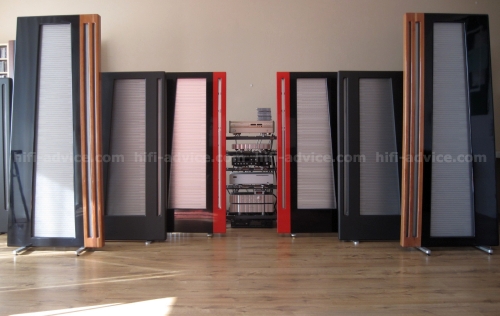
It’s like a forest, which is why I call it the “Apogee Woods”. Lately friends consistently aks me if I have planted any new trees… man, this hobby is getting out of hand..
Aquiring the Divas
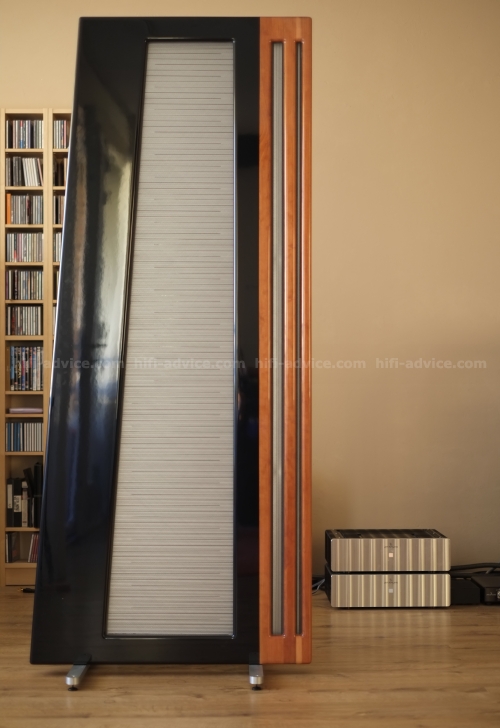
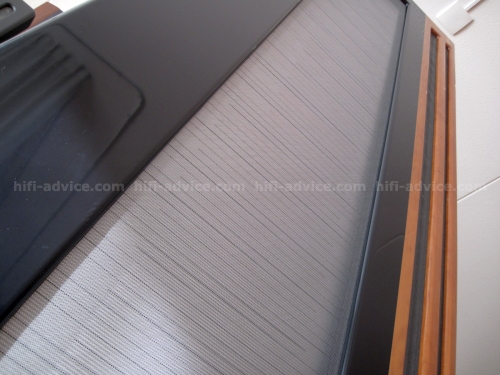
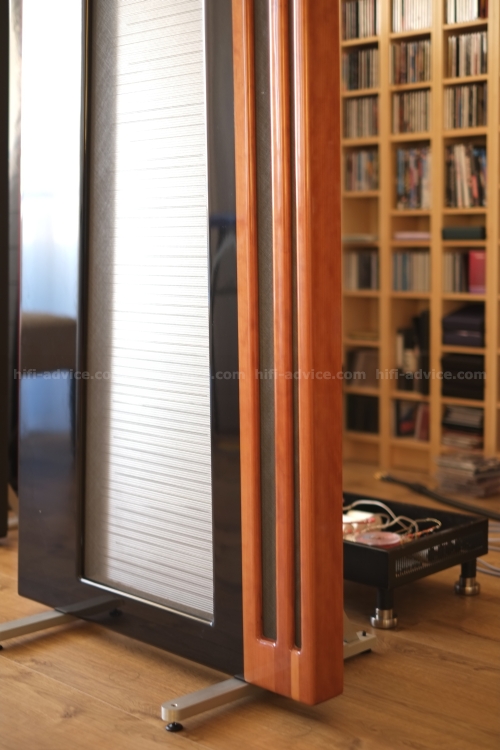
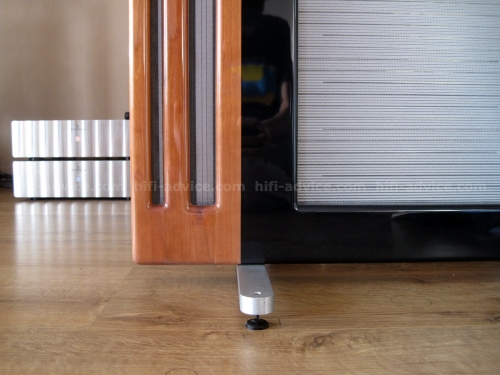
It really helps if you know the right people. After Michel had introduced me to Niels and his Full Range setup, he has now brought me into contact with someone who was selling a pristine set of Divas, completely overhauled. New ribbons, new foils, Cardas wiring throughout, new Crossovers (better treble I hoped?) and new cabinets. The latter really are something special: they consist of a combination of solid Cherrywood and MDF. The transition between the two is perfectly smooth and the whole is covered in piano laquer. What’s more: even the crossovers have been re-built and have beautiful cherrywood cabinets. These speakers truely are a piece of art and from their impeccable finish it’s evident that the cabinets are constructed by the same person that did Niels’ Full Ranges.
After the seller of the Divas and I came to an agreement, we planned for a listening session, using moderately powered Jadis preamp and poweramp (types escape me) and a Wadia 860. The resultant sound was pleasantly smooth and rich, but lacking power and drive. Treble was ok: quite allright off-axis but not very airy and a bit toned down in the listening spot but at that time I guessed that this was more the result of the already darkish Wadia 860 coupled to less-airy-than-rowland Jadis amps in a less than perfect set up. So, I played a few tracks, most importantly the one with which I know that the bass ribbons will buzz if they have a problem and decided that I wanted them.
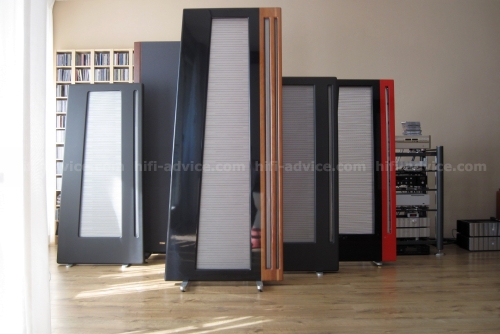
Apogee Woods from a different angle – it’s going to be boring over here when only the Divas remain…
Transport
When it was time to load the speakers into the car I realised I had underestimated the effort involved. Not only was there more than 70KG weight to reckon with but there were no crates or boxes so we had to be very careful not to damage the beautiful laquer in the process. We decided to take one speaker at a time. They really are beasts: they take up all available space of a large Volvo stationwagon: we even had to drive with the rear door open. All went well and a few hours later we had moved both speakers and all the associated stuff from the previous owner’s place to my place. I was so consumed by the process that I entirely forgot to take pictures of the previous owner’s setup as well as the move itself. Ah well, you get the idea…
Set Up
It’s possible to get these speakers up on their feet with only two people, but I really recommend three, to minimise the chance of damage. If it starts tipping over, there’s no way that one person can stop it from falling. They have to be stood up straight, then titled while the footercage is moved in position under them. Then, while two people hold the speaker up and carefully move it in position, the feet are attached by means of 4 screws. Don’t think of inserting the spikes without using protective cups under them – with the weight they’re carrying, the spikes will pierce any wood or laminate floor, and your thumbs along with it!
First position was roughly in the same place as the Duetta Signatures but there was poor focus and little layering to speak of. After moving left, right, back and forth all night, the best position turned out to be with the tweeter in almost the same position as the Duetta Signature’s MRTW ribbon. The Diva’s midrange ribbon will thus be further apart. Placing the Diva’s midrange ribbon into the old Duetta Signature MRTW’s position made for a narrow soundstage with a forward midrange and lack of spaciousness.
Even after the “optimal” position was found, I kept moving the speakers in all directions for hours but couldn’t find a spot where they had focus and soundstage layering as good as either original or refurbished set of Duetta Signatures. There is some focus (not an entire lack thereof), but it is not razor-sharp and seems to lack coherence, and this reminded me of what I heard with the Full Ranges at Niels’s setup. That, I so figured, wasn’t merely a matter of acoustics, listening distance and room size, but also perhaps of speaker complexity. It seemed that having separate ribbons for midrange and treble would make for a less focused sound. I would later learn that there was another major contributing factor.
In addition to the less than Duetta-like-soundstaging, there was something else that bothered me. You probably guessed it: treble. It’s not that the Divas are dark per se, but I would say that their treble ribbons are definitely toned down in output. Because my Magnepan MG3.6R’s have very similar treble ribbons and have superbly open treble with lots of air, I figure that the root of the problem must be in the crossovers, but for these Divas, those have been rebuilt! So, apparently, whatever treble energy reduction was present in the original crossovers, carried over into the new ones. It wasn’t until the third day that I noticed how the treble was nicely open and airy on axis (right in front of the speaker) and dulled in the sweet spot. It reminded me of comb-filter effects and then of out-of-phase problems. What if the treble wasn’t in phase with the midrange? I decided to inspect the crossovers and see if something can be done.
Update december 2013
As it would later turn out, not only my speakers, but also Niels’ Full Ranges, had phase problems. But please read on for the whole story.
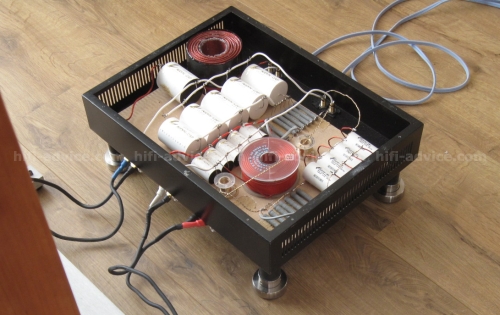
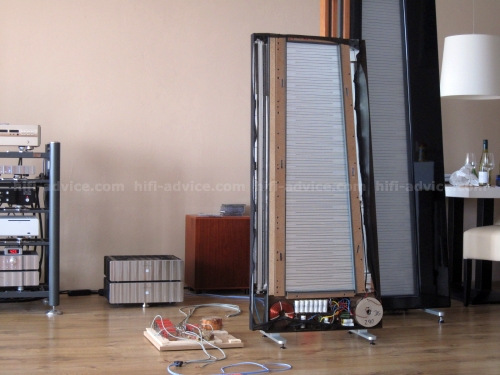
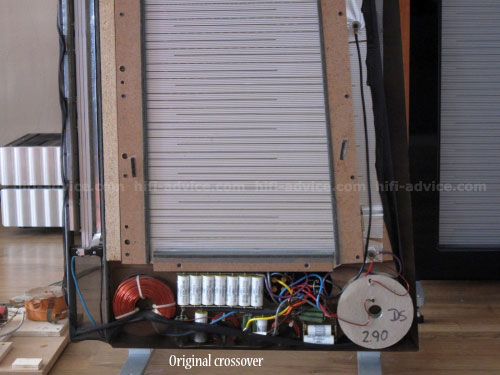
Wiring was colour-coded by the restorer and I initially just wired the speakers up accordingly. As can be seen in the image, by now I had reversed the tweeters already but more was to come…
Diva treble characteristics
The treble dullness that I hear in all Divas is surely not a defect, or a defect in my hearing for that matter. At this moment I have 3 sets of Duetta Signatures in the room, along with the Magnepan MG3.6R’s and in the other room I have B&W Nautilus 804’s and 805’s. Compared to either Duetta pair or the Magnepans, or even the N804’s, the Divas sound audibly rolled off without the treble resistor-bypass. But it’s not the first time I hear a speaker sound this way. The big and costly B&W 800D’s were the same. As were the Avalon Eclipses and I recall a few other instances in which I felt this way. So, it’s not my ears, or the room, rather, it must be a design choice. But likely not something reviewers would normally comment negatively about.
I did read somewhere that a respected reviewer commented that the Divas don’t have exaggerated treble, but that they’re just pure and natural, as treble should be. Of course it’s all relative, about design choices and personal taste plays a large role as well. So, are Divas dark-sounding? This depends on your personal experience and taste. They don’t really lack treble – it’s all there, to these ears it’s just toned down a bit and lacking some air. And I don’t feel like that with the Duettas or Centaurs, or with the Magnepans for that matter.
But as you can read below, for me this is no longer an issue as I fixed this by means of substituting a different value for the treble resistors, resulting in treble on par with Dueatta Signatures, if still not on par with Magnepan MG3.6R’s.
Troubleshooting – Treble
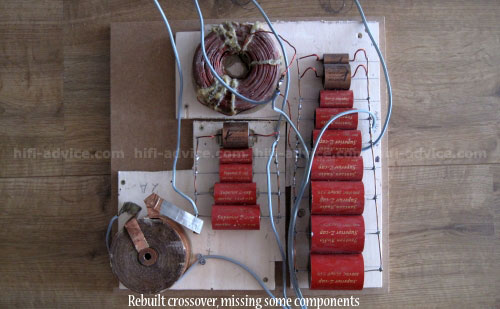
The crossovers that came with this set of Divas were not original – they had been rebuilt using better components. All the adjustment switches had been removed in the process leaving me with the question: what fixed position were they now in? Judging from the lack of real treble energy I figured that treble had to be in the lowest position and from looking inside the crossover box, this did indeed seem to be the case as there were a plethora of resistors in a combination of series and parallel connection in the circuit leading to the tweeter. I bypassed the resistors and you guessed it: we now had excellent treble, airy and refined yet very articulate. But still there was this strange phenomenon that the treble was only good off axis but absolutely dulled in the sweet spot. This would later turn out to be a phase problem.
In an effort to rule out problems with the Diva’s new crossovers, the first thing I tried was to connect the Duetta Sigs’ external crossover to the Diva, effectively making the Diva a 2-way speaker, leaving the treble disconnected. But since the Diva’s midrange seems to be a longer version of the Duetta’s MRTW, there would be no harm done. Actually: the sound improved a lot! The soundstage was more coherent, wider and deeper and overall more 3D and treble was also more open, in spite of lacking a pure ribbon tweeter this time. Also: there were no weird phasey problems anymore: treble energy was stable no matter where I listened, also in the sweet spot. Now I knew for certain that there had to be something with the new Diva crossovers.
As hinted at above, I suspected that the treble foils were connected with incorrect phase. Empowered by the positive outcome of using the Duetta Sigs’ crossovers, upon reconnecting the Diva’s crossovers, I decided to just connect the tweeters the other way around. Guess what? Treble was now nicely open and airy! But the best thing was that I now heard excellent treble both on axis as well as in the sweet spot, and what’s more: soundstage focus and layering had now also greatly improved.
Update December 2013
Once I was able to precisely obtain the values of the resistors, inductors and capacitors used by Henk in my crossover, comparing them to schematics of the original Divas, it became clear that my ears had not betrayed me: let’s say that several liberties were taken with the values. For example, treble was on a lower setting than the lowest one in the original crossover and more importantly, midrange uses a 10 times higher value for the serial inductor than in the original design. There were various other deviations and while they might work together to create a new, balanced, sound, I am not convinced and am currently in the process of selecting parts that match the original values. I will report back once done.
Whether or not this was all done on purpose, at the client’s wish, or by mistake, I don’t know. But the fact of the matter is that apparently the restorer didn’t notice the phase problems, nor did the previous owner. Or perhaps it was the very reason for selling them on. Whatever the reason, I was happy to have found the culprit of the treble problem but there would turn out to be more to come…
Troubleshooting – Midrange
Next was the midrange. Like with the treble, I had no way of knowing what position the switches were fixed in. But I found the midrange to be a pretty laid back compared to the very lively Refurbished Duetta Sigs, and even so when compared to the original Duetta Sigs. so I experimented with bypassing the resistors. There are two resistorgroups in series which affected different aspects of the frequency spectrum when bypassed. One group added lower midrange, the other the higher midrange. It was quickly evident that entirely bypassing both groups resulted in a very lively midrange, but with some screetchyness when playing certain sounds. Not surprising, because one of the resistorgroups was in parallel with a coil and as such apparently forms a notch filter, designed to suppress peaks on certain (crossover) frequencies. Eventually the best solution was to retain this notch filter but change the resistor values. This I did by trial and error, using various values of high end Mundorf Supreme resistors, but because these are very expensive at 13 euro pp (and the need to use multiples per crossover) I first broadly decided on the value by means of a variable resistor. I then bought a range of values starting below and ending higher than the value I measured and soldered them in. Over the coarse of two weeks I closed in toward a more balanced sound and by now I think I am very, very close. I’m taking my time but I could be one more tweak away from perfection. It would be interesting to measure somehow at what position I have then ended up with respect to the original filter that I sadly don’t have at hand. But in the end, all that matters is how it sounds to my ears.
Now that treble and midrange were closer in openness to the Duettas, the only remaining item for me was that the Duettas sound fuller and richer in the bass. This is very much a feature of the Duetta, but one substantiated by the components used in their rebuilt crossovers in case of the Refurbished set. The latter even cause a severe room-mode excitement which all other Apogees (original Duetta Sigs included) don’t do. For the bass, the previous owner uses a Jansen Wax Copper Foil Coil whereas the rebuilt Diva crossover uses an Intertechnik Tritherm braided litze Coil. The techniques couldn’t be any more different. Of course this is a matter of taste and one might well have a preference for one over the other. My guess is that the Inter Technik coils used in my Diva crossover are more accurate but also causing the bass to be less voluptuous than it can be using the Jansen foil coils. Also, I suspect that the imaging can be improved (or at least, changed in character) by this coil, as well as by carefully replacing some caps with other brands. This is admittedly all going a little bit over the edge, and I’m quite happy with how they sound now, so that might be an experiment for another time. The good thing is that, due to the crossover being external, such changes can always easily be reverted if need be.
Update December 2013
After I had intentionally lowered the resistor values for the midrange, in an attempt at making it more open-sounding, and more on par with the Duetta Signatures, I would find out that the midrange was actually wired out of phase, which in hindsight accounted for the lack of presence. This would in turn prompt me to use a higher resistor value again for the midrange. But I’m getting ahead of myself.
Now that I was happy with the treble and almost content with the midrange, there was still one area that I wasn’t entirely happy with…
Power
The Divas go seriously loud. In fact I have not yet met their limit. The official specs state that a 100-watt amp, capable of 20 amps, is recommended. The Sixes have 150 watts and can deliver 50 Amps. As such they would seem overly powerful already but because the Divas just never run out of headroom! I suspect that they could work with even much more power without fear for breakdown. As Michel already noticed with his Divas (using 4 Rowland “Ice Power” 201’s): he can crank up the levels to his heart’s content, without any ear ache. That’s just a testament to how pure and undistorted the Divas sound. On my turn I also noticed that when I had “misbehaved” this way, that my ears never grew tired, and that it always went without any subsequent ear-ringing, as can happen with big dynamic speakers. But enough about power. Let’s discuss the finer aspects of these wonderful speakers.
Resolution
Before I modified the Divas’ crossovers, contrary to either set of Duettas (originals or refurbished), the Divas didn’t sound very open when playing very softly. They seemed to need some kick in the butt before taking off. After I changed the resistor values in the crossovers, the Divas now sound much more open but still they apparently like to play a little louder than the Duettas. Nothing to worry about though because I’m not talking LOUD, just not whisper-quiet, which the Magnepans actually do better, and to an extent, so do the Duettas.
But I can’t help but think that in spite of the presence of a similar true ribbon tweeter, the Divas’ low level resolution is sligthly less than that of the Magnepans. Then again, perceived resolution is often a function of treble openness, and just this area I find to be a little lacking. It’s not only me by the way: if I remember correctly, a well know magazine’s measured response shows a marked treble decay from around 12 kHz, in spite of the speaker’s quoted +-3dB 25 Hz-25 kHz spec. But this probably has been counteracted by my bypassing the tweeter resistors. The Diva’s treble, as well as the Duetta’s, seems to be more articulate however, more rhythmic (more accurate?) than that of the Magnepans. It might also be the case that the Magnepans sound more smeared in the treble and therefor seem to be more liquid, and conseqently, more resolving. But this is slightly nitpicking and the Divas really do have excellent treble, definitely better than any dynamic speaker I know. Overall, the Divas have very, very good resolution, but it is not up to the latest Martin Logan standard. Then again, in my opinion there’s no Logan that sounds as acoustically convincing and life-like as almost any Apogee. There’s more in life than treble air and overall resolution, such as midrange quality!
Midrange
Arguably the Diva’s strongest field is their midrange. Unsurprisingly perhaps, since it spans all the way from 550khz up to 12khz, so almost producing the sound of most instruments and vocals entirely in one driver. The Diva’s midrange is extremely lifelike and natural. It’s also uncolored and neutral, but not thin or threadbare nor metallic and shouty. The dynamic range is spectacular: voices are tracked with lightning speed, they can be mellow and intimate and full-on storm level but never does the midrange harden up. Voices are wholly convincing while offering much of the exciting live-feeling that I experienced with the Duetta Sigs and even more so with the refurbed ones, albeit much in a more natural manner. In comparison, the Refurbished Duettas are lean-sounding, slightly metallic and a bit shouty. I already mentioned in the Duetta review that their timbre is spot on, which is certainly true when comparing to Magnepan MG3.6, but after having heard the Divas for a week and switching to the Duettas, I wouldn’t rush to say that anymore. That’s just how superbly natural the Divas are. They make other speakers sound coloured and uneven.
Duetta Crossover swapping
That said, it wasn’t until we connected the newly built Duetta crossovers to the original Duettas that we had an ear-opener. We were shocked to hear how much the sound degraded! Sure, bass was fuller and the midrange was more forward and lively but the transparency and more so the coherence was greatly reduced, not to mention that the original set now also sounded screetchy and way too forward. Stop the clock – this meant that my initial assessment of the refurbished Duettas was flawed due to the “wrong” crossover. After some correspondence with the Duetta’s previous owner, it became clear that he had removed some components from the crossover, in an effort to make them purer, and according to his ears, more transparent. But in the process it also made the MRTW much louder than it should be. I guess this was much of a system synergy thing because to my ears, the new crossovers actually sounded less transparent and not at all more detailed. It does also, to an extent, explain the midrange shoutyness.
Update December 2013
We will try to revert the new Duetta crossovers back to the original values and once done, I will report back.
So, comparing the Divas to the refurbished Duetta Sigs was unfair and trying to obtain the same “lively” midrange would be impossible unless I, too, would bypass more components in the crossover. This, I was not prepared to do. Also, comparing the Divas to the original Duettas was much more fair and also quite an ear-opener. The originals, like the refurbished ones, have a get-up-and-go that the Divas seem to lack. Their sound is just more coherent, of one apparent source and a little bit more explosive. But the arguments stated above regarding metallic sound still hold true, but to a much lesser extent. Still, after hearing Divas, most other speakers’ midrange will probably sound less natural.
Update December 2013
After I had done some more phase-connectivity research, later it would turn out that the Divas can actually sound just as coherent as the Duettas, refurbished or no. Imaging, too, is at the same level, at least. And that’s in spite of the 3 way crossover and the doubts I had about that. What’s more: the Divas now have a deeper sense of layering in the soundstage than the Duettas do.
Back to the Diva – More Listening
Other than having less balls in the bass the refurbished set of Duetta Sigs, the Divas really are spectacular speakers. For starters: there’s not a hint of the brittleness and shouty forwardness that is present in JW’s refurbished Duetta Signatures. This is admittedly due to the no-standard crossover, but the original Duetta Sigs also sound a little too clean, too lean in the midrange, when compared to the Divas. The Diva’s treble is pure and utterly distortion-free. I guess we can state that apparently the new Graz ribbons are not inherently metallic or rough-sounding. Oh, and on the subject of soundstage: like the Duettas, the Divas are less wide and room-filling than Magnepans. The latter always sound big, even with CD’s not recorded that way. Some people don’t like that but it’s fine by me. All Apogees I heard are different: they don’t sound big unless that’s a property of the recording. But you better believe the Divas can really fill the room if asked to! The Duettas were already capable of throwing a large stage but the Divas go one step further toward that live feeling. Also they do provide good layering in the depth plane, definitely on par, if not better, than the Magnepans. Bringing to mind the Avalon Eclipses, I think they had even better layering and staging in all directions, but they couldn’t touch the Divas’ lifelike timbre, dynamics and neutrality.
Dynamics
All Apogees I heard are champions at dynamic contrasts. Part of why this is the case if probably that they are very fast and make use of extremely powerful magnets. The Divas, albeit less explosive than Dueatta Sigs, are no exception.
Bass
Even if the Divas have almost twice the bass radiating area of the Dueatta Signatures, they actually don’t sound bass-heavy at all. Rather, neutral and we



Stereo Times Masthead
Publisher/Founder
Clement Perry
Editor
Dave Thomas
Senior Editors
Frank Alles, Mike Girardi, Russell Lichter, Terry London, Moreno Mitchell, Paul Szabady, Bill Wells, Mike Wright, and Stephen Yan,
Current Contributors
David Abramson, Tim Barrall, Dave Allison, Ron Cook, Lewis Dardick, John Hoffman, Dan Secula, Don Shaulis, Greg Simmons, Eric Teh, Greg Voth, Richard Willie, Ed Van Winkle, Rob Dockery, Richard Doron, and Daveed Turek
Site Management Clement Perry
Ad Designer: Martin Perry
Be the first to comment on: APOGEE ACOUSTICS DIVA