

Rosso Fiorentino Arno 20 loudspeakers by Terry London
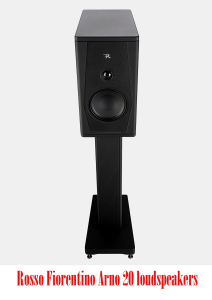
 It has been about a year since I reviewed the Rosso Fiorentino 40 loudspeaker (here). I was so impressed by their combination of build quality, elegant appearance, and, finally and most importantly, the way the speaker presented music in an engaging and relaxing manner. The experience allowed me to connect more deeply with the music’s emotional context than with any other loudspeaker I had ever used in my system. I purchased the review pair and put the Arno 40 loudspeakers on the Stereo Times “Most Wanted Components List” for 2024. Because of this experience, I reached out again to Skip Skipworth of Audio Thesis, the U.S. importer for Rosso Fiorentino, to set up the review of the stand-mount Arno 20 loudspeaker, which retails for $7000 a pair. The manufacturer Rosso Fiorentino is located in Florence, Italy. The company was founded in 2007 by Francesco Rubenni, who is the CEO/Designer. Besides my extensive experience with the Arno 40 and now spending time with the smaller brother, the stand-mount Arno 20, Francesco ranks among the finest designers and builders of world-class speakers in today’s market, regardless of price bracket.
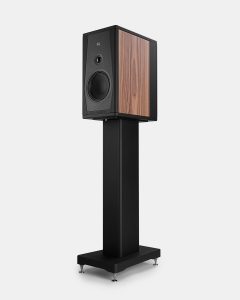
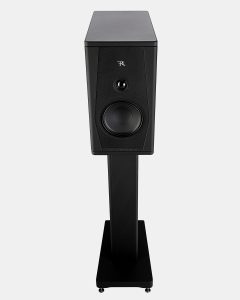
The demo pair of Arno 20 loudspeakers that were sent for review was clad in perfectly matched walnut side veneer. The front baffle is covered in high-quality black leather. Just like its big brother, the Arno 40, the Arno 20’s top, front, and back are black and use a proprietary constrained-layer damping method composed of anodized aluminum and layers of solid HDF and rubber, which eliminate spurious and contaminating vibrations. Each Arno 20 weighs 35.3 pounds. Covers are provided that attach via embedded, unseen magnets. The physical appearance of the Arno 20 is understated yet classy and elegant, and the build quality is evident.
S-A20 Stand
 This info was gleaned from their website: The Rosso Fiorentino S-A20 stand is designed to provide a robust and acoustically optimized base for the Arno20 bookshelf loudspeakers. Its elegant matte black soft-touch finish complements the design language of Rosso Fiorentino’s latest models. Key features include a front compartment filled with marble microgranules that convert kinetic energy into heat, dissipating vibrations and enhancing overall sound quality. A wide rear cable channel provides clean, practical cable management, while adjustable spikes enable straightforward, secure installation. For additional stability and vibration control, the speaker can be screwed directly onto the top plate, ensuring a rigid mechanical connection. Constructed from HDF with a refined soft-touch paint finish, the S-A20 stand combines technical performance with Italian design elegance. An embossed Rosso Fiorentino logo on the central leather band adds a distinctive visual accent. The S-A20 offers both functional excellence and sophisticated aesthetics to fully support and elevate the performance of the Arno20 loudspeakers.
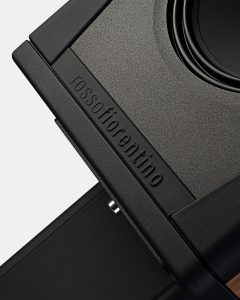

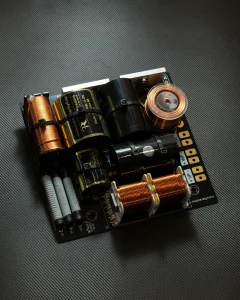
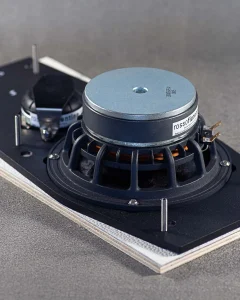
The Arno 20 is a two-way design. The tweeter is a 1.1-inch silk-dome neodymium driver, the same driver used in the Arno 40. Recently, I watched a Paul McGowan YouTube video in which a listener asked him which driver is most important in a loudspeaker design. Paul’s answer was the tweeter. Credit to him, he’s right. How many loudspeakers have I listened to that, because of a bright/harsh, “hot”/metallic, or very detailed yet mechanical-sounding tweeter, turned out to be a very unpleasant listening experience for me? The Arno 20’s silk dome transducer offers remarkable micro-details, sparkle, and shimmer with an airy openness that never hardens or gets bright unless it’s on the recording. It also provides vibrant and natural timbres and colors in the high-end frequencies. The mid-woofer is a 6.5-inch paper-cone specifically designed for the Arno 20. These drivers are based on a proprietary line of transducers. These drivers were developed in a mutual collaboration with a leading Italian manufacturer and Rosso Fiorentino.
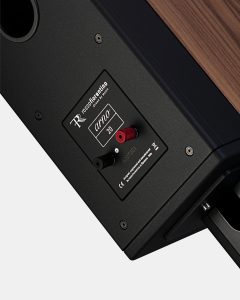
I placed the Arno 20 speakers in my smaller upstairs system. They are rear-ported, so for optimum bass performance with no boominess, they were placed 3.5 feet from the front wall and positioned 8 feet apart with a slight toe-in. I decided to use the same musical selections I used in the Arno 40 review to evaluate how closely the smaller brother, the Arno 20 stand-mount speakers, would match the performance of the twice-as-expensive Arno 40 model. These selections were:
- Lee Morgan’s Blue Note album “Candy”. This recording gives me an excellent sense of a speaker’s ability with timbre, tonality/color.
- Count Basie’s Analogue Production album “Farmers Market Barbecue”. I use this recording to measure a speaker’s ability to render a realistic soundstage in height, depth, and width, along with the precise positions of the players on that stage and how three-dimensional they sound in space.
- Conrad Herwig’s High Note album “Sketches of Spain Y Mas”. This recording gives me an outstanding take on a speaker’s ability with macro-dynamics, low-end extension, explosive Latin percussion, and overall “aliveness”/ transient speed.
Let’s start with the Arno 20 loudspeaker’s ability with spatial qualities. The Arno 20 completely disappeared and, on the recording, created a deep soundstage that transcended the speakers’ outer edges. The space between the individual instruments was very clearly rendered, and each player had excellent image density and solidarity.
 The most important attribute for me as a listener is how a loudspeaker reproduces timbres/tonality/color across the sonic spectrum. The Arno 20 loudspeakers, thanks to the tweeter I discussed earlier in the review, seamlessly blended with the natural paper-treated mid-woofer driver to deliver what I call an “oil painting” of tonality, with rich color density, that accurately and naturally recreated the timbres of the different instruments. Just as the Arno 40 loudspeaker’s beautiful and engaging abilities with color and tonality, the smaller sibling, the Arno 20 loudspeaker, demonstrates equal prowess in this regard. I also became aware during the review process that the Arno 20 had a level of transparency that would compete with some of the best electrostatic designs, rivaling the smallest micro-details in the music with a natural ease. Another outstanding attribute of the Arno 20 speaker was its bass extension and control. For a relatively small stand mount speaker, the Arno 20 does what I call the power region, the lower mid-range and upper bass region, with remarkable authority/control that gives music a real life presence. There’s no artificial “hump” tuned in to achieve this effect; everything remains linear from top to bottom. Whatever Francesco and his team did, either with some x-over “magic” along with their choice of drivers, the Arno 40 gives you the power region presence without any discontinuity, and the lower bass frequencies are taut and accurate at the same time.
All of the above sonic characteristics make the Rosso Fiorentino Arno 20 a very special speaker. However, for me as a listener, the following statement makes the Arno 20, just like my pair of Arno 40 speakers, very unique. All of the above, gorgeous colors, see-through transparency rendering easy to hear micro-details, transient speed, world-class sound-staging, and remarkable bass authority/extension are all presented in a terrific, relaxing, charming, and engaging manner, which is part of the house sound of Rosso Fiorentino. That’s why I put the Arno 20 loudspeakers on the 2025 ‘Most Wanted Components list”. Finally, because I know some of my readers will ask, “How close does the Arno 20’s performance come to the Arno 40’s?” The Arno 40 speakers have two additional bass drivers, so they will go deeper and better pressurize a larger space. However, in a small to medium-sized room, I would go for the Arno 20s because they will do fine with bass extension and control, and have the other sonic virtues of the larger Arno 40 speakers.

SPECIFICATIONS:
Rosso Fiorentino Arno 20 loudspeaker
Price $7000 a pair
Dimensions: H 16.25 inches x W 8.7 inches x D 13.45 inches
Weight: 35.3 pounds per speaker
Sensitivity: 87 dB
Nominal Impedance: 8 ohms
Drivers: 1.1“ silk dome neodymium tweeter / 6.5“ mid-woofer
Rear ported / one pair of speaker wire terminals
Website: https://rossofiorentino.com/arno-20/
TJ’s Associated Equipment
Source:
Reimyo DAP-999EX Toku DAC
Audio Note (UK) DAC 4.1 Balanced Signature
Pro-Jet Reference CD transport & LTA power supply
Wadia 22 transport
Amplification:
Coda 5.5 amplifier
Naiu Labs Ella MKII amplifier
AricAudio Custom Balanced 5751 tube-based preamplifier
Loudspeakers:
Rosso Fiorentino Arno 40
NSMT System Two
Tekton Design Ulfberth
Music Design Knight V2
Accessories:
Jena Labs reference AES/EBU digital cable
Vermouth Audio Black Pearl MKIII XLRs
Vermouth Reference speaker cable
Krolo Design reference rack & footers
Vermouth reference & Black Pearl power cords
Puritan Audio AC power conditioner & grounding system

Stereo Times Masthead
Publisher/Founder
Clement Perry
Editor
Dave Thomas
Senior Editors
Frank Alles, Mike Girardi, Russell Lichter, Terry London, Moreno Mitchell, Paul Szabady, Bill Wells, Mike Wright, and Stephen Yan,
Current Contributors
David Abramson, Tim Barrall, Dave Allison, Ron Cook, Lewis Dardick, John Hoffman, Dan Secula, Don Shaulis, Greg Simmons, Eric Teh, Greg Voth, Richard Willie, Ed Van Winkle, Rob Dockery, Richard Doron, and Daveed Turek
Site Management Clement Perry
Ad Designer: Martin Perry
Be the first to comment on: Rosso Fiorentino Arno 20 loudspeakers by Terry London